Before You Begin
This guide goes along with the episode. Read it after you listen, or keep it open while you listen and write in the margins.
Who this is for: If you're listening to this, you're either newly in the chemsex free journey, or you want to be, or you have a loved one who's there, or you just want to know more information about it. This could help pretty much anybody, really. But especially if you've been trying to quit and you can't seem to get over that last hurdle. You're relapsing every month, maybe every two weeks, maybe every six months, whatever it is, and you just can't seem to get that last one out.
The Framework
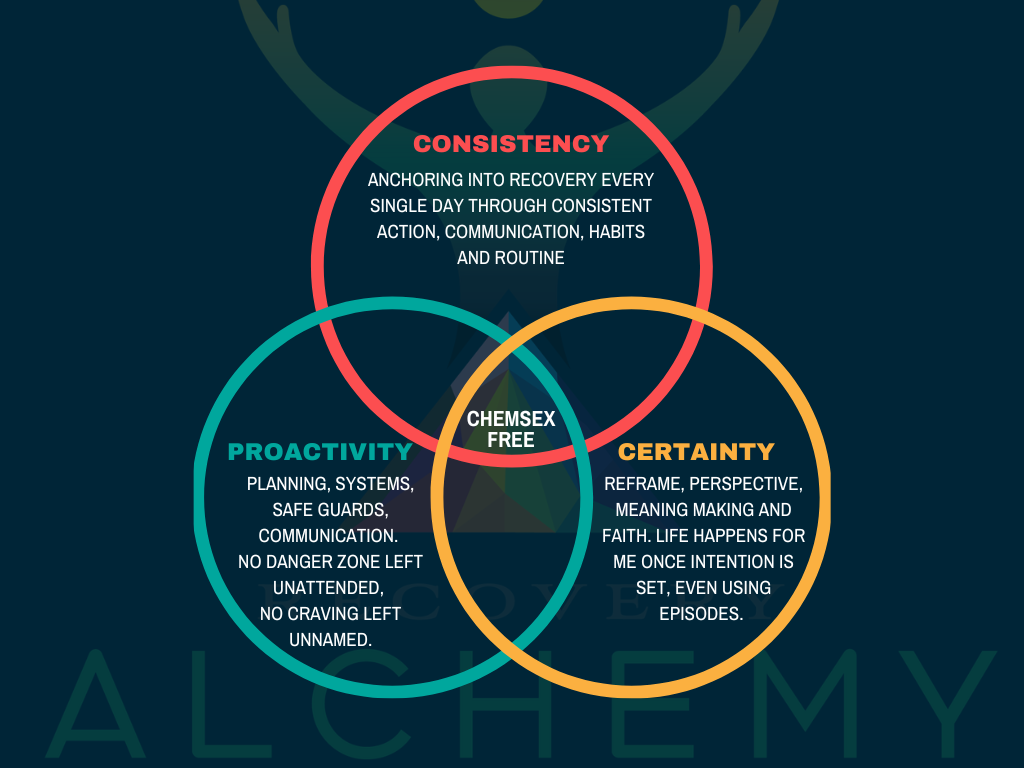
Picture three overlapping circles: Consistency, Proactivity, and Certainty. Where all three overlap in the middle is chemsex free.
None of these by themselves is going to get you there. All of them together, it's ironclad.
Pillar One: Consistency
Anchoring into recovery every single day through consistent action, consistent communication, habits, and routine.
The liminal space
Consistency will help you in the very beginning, in that liminal space between when you are quitting, when you have quit, and now you have all this time and space and energy.
You don't really realize just how much you're investing into chemsex until you go back and look at it. The time it takes to decide whether or not I'm doing it. The time it takes to call the dealer, or find the users, or go on Grindr, or hire the escort, whatever it is. Then the using. Then the come down. Then what you take away from your life, from your job, from your family, from your friends, from yourself.
So even if you use once a month, that's about half the month gone.
And as you get older, it takes a lot longer to recover. It seems like once you hit forty, the body starts saying, whoa, enough of this shit. Then fifty. Then sixty. My guys in their sixties, it takes them a good two to three weeks sometimes to feel back to normal in their body.
So there is this space of time where you feel bored. You feel like you're buffering, like you don't know what to do with yourself. You're in between identities. You left a lifestyle.
Here's the thing: chemsex is not just a drug. It's a culture, a subculture, a lifestyle. It's part of you. It's an identity. And when you're shifting identities, when you're on a new timeline, when you're doing new things and thinking new ways and behaving new ways, there's an in between here where you're oscillating, you're ambivalent, you just don't know what to do.
And most guys will say, well, I'm just so bored.
On boredom
Boredom comes from not having a compelling enough vision for where you're going.
If you're bored, that means there's not enough emotional pull. There's not enough of you attached to the person you're becoming next. You haven't taken the time to really visualize that version of you and latch on to him. There's no core emotional driver fueling you forward.
That's why you're bored.
Your two daily metrics
You want to set a metric: I'm going to do this consistently every day.
1. A consistent daily action. Whatever feels natural, whatever feels aligned, whatever feels like the path of least resistance. Journaling is a common one. Maybe it's the gym. Maybe it's whatever the hell you want it to be. Commit to it. Maybe it's just for one minute.
2. A consistent daily communication. If you're one of those guys battling this in isolation because you're afraid to tell your friends and your family and your coworkers, you don't have to establish a daily communication to discuss specifically your chemsex recovery. But you do want to have an outreach. You want to build that communication muscle so that you can get stuff out of your body, out of your mind, and into the air, so it doesn't grow and fester.
That is where you can begin. And these are your metrics.
The missed day is the alert
The first day that you don't do one of them, that is your sign. That is your alert.
And you may feel fine. You may not feel any kind of urge to use. You may feel great. I don't give a shit. You cannot base this on how you feel, because you have now set a standard for yourself. If you've missed a day, there's something in there to observe. I would guarantee it.
There's a subconscious cue. It's like one of those Rube Goldberg machines: the ball drops in the bucket, the bucket falls down, the ball rolls and hits. Something has been set off. The brain has been alerted, and the brain is putting you in that subconscious pattern, heading you toward a repeat, a relapse.
So what happens if you miss a day? Put yourself on red alert. Notify your team. You are then on complete awareness of how you're responding to life, how you're interpreting the situations in your life, at work, with family, with friends, the news. Because my guess is that missing a day means something. And then you're going to be primed. You're going to start in that emotional relapse that leads to mental relapse, that leads to physical relapse.
Habit and routine are the scaffolding
The habit and the routine are the scaffolding. I envision it as laying out train track each day. You lay the track, and then you can start to move forward.
We forget, because we don't see ourselves very well. That's the joy and the beauty of a counselor or a therapist or a coach, that they're seeing you from the third person. We forget. We veer. Some of the guys I work with go a day without doing something recovery-wise, and it's like they're drifting off toward a shiny object. It's easy.
A consistent daily action brings you back and anchors you in.
And if you can, and don't put too much pressure on yourself, make it a morning, noon, and night check-in. Something that brings you back to center and reminds you: I'm in chemsex recovery. I need to be aware of my cues. I need to be aware of my cravings. I need to be aware of my thoughts. I need to be aware of myself. And am I aligning with the future version of myself that I have envisioned and created?
Pillar Two: Proactivity
Planning, systems, communication, safeguards. No danger zone left unattended. No craving left unnamed.
Run your recovery like a business
Proactivity means you are now running your life like a business, like a businessman, like an entrepreneur, with your recovery as the business.
You want to be looking at that calendar every week. Some guys do it on Sundays. It depends on how your week is scheduled. Sunday's a good day. Sunday I'm sitting down. I'm looking at the next week.
Put on the meth thinking cap
If I were planning to use: When would I do it? How would I do it? Who would I do it with? Where would I do it?
Make a plan. And then put safeguards in place. Put barriers in place. Make it so that it cannot happen. Do this while you're feeling strong here on Sunday, while you're feeling resolved, while you have motivation and self-control and a lot of energy to spend before the week gets started.
Plan events you can't get out of. Plan sleepovers, with somebody, or somebody staying with you. Give your phone away during certain times. Alert everyone. Say it out loud: this is my danger zone. Thursday night is my danger zone. That is when I start to plan. That is when I would go out and relapse if I were going to use this week.
So go into a preemptive strike and make sure I don't have the choice to use. I don't have access to the user buddies or the dealer or the substance. And I can't get my ass out alone to do it.
I'm going to use the same manipulation I used for figuring out how to use without anybody knowing. And I'm going to use it for my good. I'm going to sabotage myself in a good way.
Get through a couple of cycles
Once you're doing that for several cycles, whatever your cycle is (maybe every two weeks, maybe every month, maybe every three months), you're starting to show your subconscious that you are in a different timeline. You are living a different life. You have interrupted the pattern.
Now your subconscious is waiting, waiting to see what's next, instead of being in control and shoving you into what's next.
And you build self-trust. You have figured out, practically, without anyone telling you what to do, you doing it, you empowering yourself, how to beat this shit.
And then eventually, no, you don't need chaperones and you don't need safeguards. You can live like a normal person. You can be alone on a Friday night if you want to be alone on a Friday night.
Map the year, then the week
But proactively, you have to be in front of this. Anniversaries of deaths or breakups. Holidays. Pride. Birthday parties. Clubbing events. Places and times all through the year.
Look at your year. When have you typically used? Where are your danger zones?
But more often it's each week. Where am I? How am I? Who am I? When will I use? And now I'm going to get in front of myself.
If you're coming back from a holiday, if your partner's going to be out of town for a week, think about it. Don't get caught with your pants down, figuratively and literally, in the middle of a weekend with nothing to do and a phone in your hand.
Pillar Three: Certainty
Reframing, perspective shifting, meaning making, and faith. Life happens for me once intention is set.
This is the one where sometimes it's very difficult to get across.
It is all happening for me
If I accept that every single thing in my life has happened for me, is happening for me, and will happen for me, then I am not living in suffering. I am not ruminating on the past. I am not projecting on the future. I am not thinking that I'm not enough right now. I'm not wishing I was more. I am not spiraling over a use.
I believe that this happened for me. This relapse happened for me because I needed to know where I needed more safeguards. I needed to know where doors were still open. I needed an assessment of just how much I'm ready to stop.
Sometimes you're just not ready to stop. And the more you deny that and keep it hidden, the more it grows.
Say it. Admit it. Even if it's just to yourself. Say it out loud: I'm not ready to stop.
There's a power in that, because it's truth. You're being honest. And that truth really does set you free.
The use is data
Learning episodes. Data points. Using episodes. Whatever you call them. That's it. Period.
It's not what happened to you, it's how you responded to it. Same with relapse.
So many of you are getting caught up in starting days over, and I've lost time, and giving up and disappearing for weeks after you use. The more you do this, the more you're going to want to use, because you're disempowering yourself. And you're missing out on the very juicy information that these uses are giving you.
So many men in my program, when they use, it's the turning point, the trajectory. It is the moment their recovery truly takes a turn, because of the way they respond to it.
Isn't this interesting? I used. Let me look at this. Let me study this. It gave me some things. It cost me some things. I'm going to see it as a neutral experience.
Just like going to the grocery store. I went to the grocery store. I used meth. They carry the same amount of importance. It's an experience in your life.
Sometimes you have to use to learn how not to use. But we're so afraid of it, and we're taught that you failed, and all of that overshadows what the use was trying to show you.
You're going to keep doing it until you learn the lesson. You're going to keep dating the same man until you learn the lesson. You're going to keep getting fired from the same job until you learn the lesson. It's all learning.
Once you stop using, the real work begins
Because all the stuff you've been numbing and avoiding is ready to come up. And all the people around you whose behavior you've been numbing right in front of you, and you're a raw nerve.
But all of that is happening for you, so that you can face it.
Feeling is healing. You can face it, you can feel it, you can be in it. You can show your subconscious that your life's not in danger. That if you feel isolated, if you feel lonely on a Friday night, you're not going to die.
You're there alone for a purpose. For you to get closer to you.
You're lonely because you're fragmented inside. No amount of people, no amount of crowd, is going to help you feel less lonely. But you have to let yourself feel it.
Rejection, isolation, all of that. There's something you haven't dealt with, some big emotion from the past.
The universe wants you to be free of suffering. Your suffering is this psychological pain that you're not letting yourself feel. It wants out.
Desire and vision
No desire will ever be given to you if it isn't possible for you. It can never be conceived if it isn't possible.
You have the desire. You set the vision for it. And then you sit back and you allow it to happen. And everything on the way is happening for you to reach that desire.
You want more patience, you're going to experience circumstances that give you patience. You want more money, you're going to experience situations where you learn how to make more money. And it might be through being destitute for a minute.
We get so involved and preoccupied with meaning making. This means something bad. This means something good. This means I'm doing something wrong, I'm doing something right. Like there are scales out there. There's not. It's all neutral, moving you toward where you want to be.
The question
It comes down to being certain that it's all happening for me.
And when I respond to my life that way, how is this happening for me? How is this happening for me? How is this happening for me? Everything automatically falls in line.
I'm free from the doubt, the fear, the frustration, the lust. I'm clear. I'm free.
The universe is pushing you toward your desire. You're just steering. And you steer by your reaction and your response to what happens to you.
Putting It Together
Daily consistency. Looking ahead and being proactive. And being certain that it's all happening for me, that you're in the right place at the right time.
There's no better place for you to ever be than where you are right now, and there's no better person for you to be than who you are right now. Settle in that. Breathe. Feel your body just relieve.
The caveat: You do have to have the safeguards in place. You do have to have the blocks on your phone and all of it. All of that practical stuff has to be done first. Yes. Then you can start this work.
Then you're going to experience the best state of being you've ever imagined, and couldn't imagine, of your life.
You think that sobriety is great and it's a good life and it's a good way of being, and you're told that all the time. But wait until you experience every day expanding into somebody you want to be, without the suffering, without this mental anguish that we carry with us, these undue prisons that we lock ourselves in.
Take It Further
Study guides for this and every episode live at recoveryalchemy.org under the blog, along with a repository of topics, journal prompts, exercises, and reflective questions. The free course Reframing Relapse is there too.
If you have questions about any of this, reach out. Join the conversation on YouTube or Spotify, or DM me on social. I want to hear your impression of it. How does it seem? How does it feel? What did I miss?
And please like, subscribe, rate, and review. If you can't share it, if you can't let anybody know you listen, if it's in secret and anonymous, at least rate it. It helps the algorithm get this to the ears and eyes of those who need to hear it.
Hope this helps.
Love, Dallas
Journal Prompts
Give each one at least ten minutes. Handwrite if you can.
1. The real cost. Go back and count it. The deciding, the finding, the using, the come down, the days after. How much of your month does chemsex actually take? Write the number. Then write what you took away from your job, your family, your friends, and yourself to pay for it.
2. The boredom question. If boredom means there isn't enough emotional pull toward the person you're becoming next, then describe him. Who is he, specifically? What is his Tuesday morning like? What does he say no to without thinking about it? What is the core emotional driver that would fuel you toward him?
3. In between identities. Chemsex was not just a drug for you. It was a culture, a lifestyle, an identity. What are you actually grieving about leaving it? Name what you'll miss. Be honest, nobody is reading this.
4. Where the doors are still open. Think about your last use. Not the shame of it, the data in it. What did it give you? What did it cost you? Where were the safeguards missing? What was it trying to show you that you haven't wanted to look at? And if the honest answer right now is I'm not ready to stop, write that sentence down and see what comes after it.
5. How is this happening for me? Take the hardest thing in your life right now, the thing you'd say is happening to you. Write it at the top of the page. Then ask the question three times, and answer it three different ways: how is this happening for me?
Actionable Exercise: The Sunday Preemptive Strike
Do this once, this Sunday. Then do it again next Sunday. Give it thirty minutes.
Step 1. Put on the meth thinking cap. Open your calendar to the next seven days. Ask yourself, plainly: if I were planning to use this week, when would I do it? How would I do it? Who would I do it with? Where would I do it? Use the exact same skill you used to plan a use without anybody knowing. You're just pointing it in the other direction now.
Step 2. Name the danger zone out loud. Write it down in one sentence. "Thursday night after 9 is my danger zone. That's when I start to plan." Then say it to another human being. Out loud. That's the part most guys skip.
Step 3. Build the barrier before you need it. Make it so it cannot happen. Plan an event you can't get out of. Arrange a sleepover, either you go there or somebody comes to you. Hand your phone over for those hours. Alert your people. Cut the access: the buddies, the dealer, the substance, and the ability to get out alone. Do this now, on Sunday, while you're resolved and you have the energy to spend.
Step 4. Set your two daily metrics for the week. One consistent daily action (journaling, the gym, whatever feels like the path of least resistance) and one consistent daily communication. Write both at the top of the page. Keep the action small enough that you cannot talk yourself out of it. One minute counts.
Step 5. Write your red alert protocol. Finish this sentence before the week starts: "If I miss a day, I will ______ and I will tell ______ within ______ hours." The missed day is not a failure. It's the alert. Decide now what you do when the alarm goes off, so you're not deciding in the moment.
At the end of the week, come back to this page. What did you get right about yourself? What did you miss? That's the data. Then run it again.


Responses