Content Warning: This episode discusses meth and alcohol use, homelessness, survival sex, drug-induced psychosis, psychiatric hospitalization, HIV diagnosis, and relapse. Both guests share their stories candidly. If any of it is heavy for you right now, take your time, and consider going through this guide with someone on your recovery team.
If you are in crisis or thinking about harming yourself, call or text 988 (Suicide and Crisis Lifeline, US). For substance use support any time, call the SAMHSA National Helpline at 1-800-662-4357. Outside the US, contact your local emergency or crisis line. You do not have to carry this alone.
What This Episode Is About
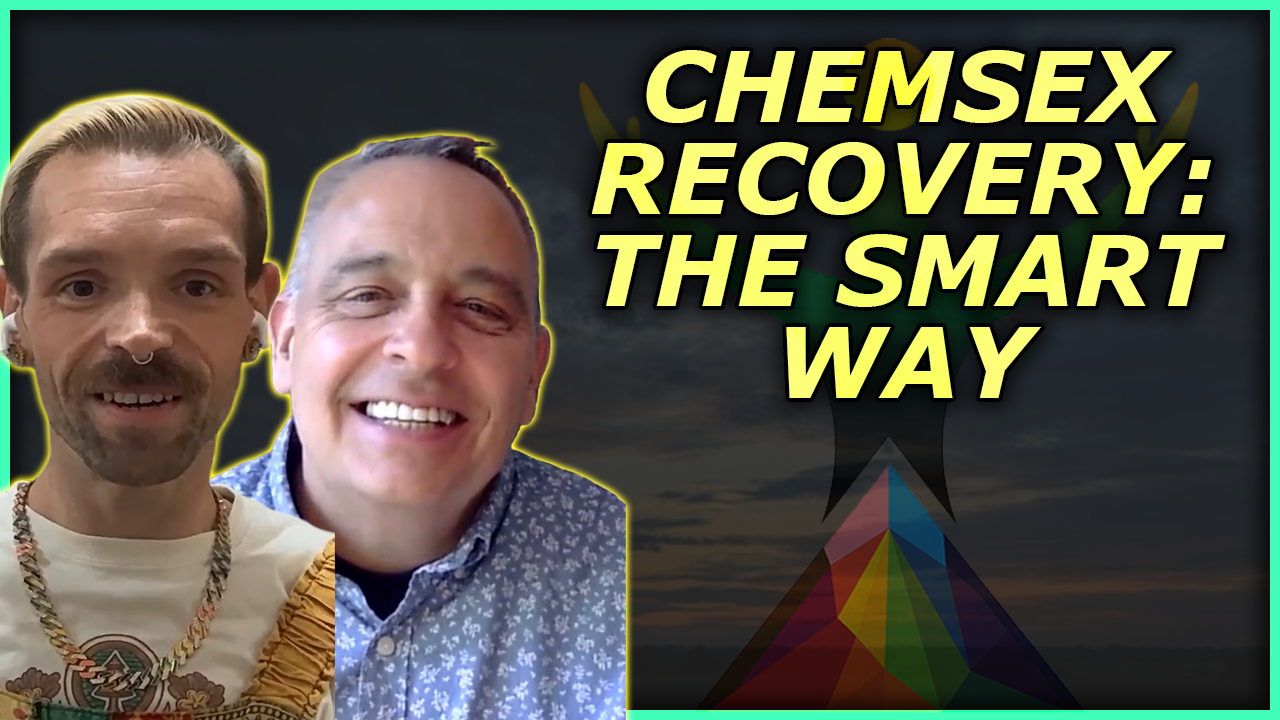
For about a year, Dallas Bragg has been trying to get alternatives to the 12 steps represented on the podcast. This episode finally does it. Dallas sits down with two new friends from SMART Recovery whose work and lived experience land squarely in chemsex territory.
Gus Curran is SMART Recovery's senior director of training and program development, a facilitator for nearly a decade, and someone who brings lived experience with alcohol, meth, and chemsex to the work. He first got sober at nineteen and stayed sober for twelve years, then discovered ecstasy in Los Angeles, which led to the all-weekend clubs, which led to meth. His use became isolated and sad: alone with porn, alone at the sex club. Treatment addressed the meth but never the sex, and he only understood years later, through SMART's LGBTQ+ facilitators, how deeply the two had been wired together. He has been meth and alcohol free for ten years and hosts an LGBTQ+ SMART meeting in Durham, North Carolina.
Zach Reedy is a substance use counselor (CASAC-T), recovery advocate, and president of SMART Recovery NYC. Raised by absent parents, Zach met meth on the apps at 27 after a breakup, and within a few years had lost their job, car, and housing. They were unhoused in Orlando and then Wilton Manors, diagnosed with HIV early in their use (which Zach credits with saving their life by getting them into care), discharged from rehab while not yet ready, living in a storage unit, and running Zoom rooms as early as 2019. After relocating to New York in 2020, daily psychosis led Zach to commit themselves to a psychiatric hospital, and a year later a neighbor took them to their first CMA meeting. Zach has been meth-free since November 23, 2022, and now brings what they learned in 12-step fellowship into building community inside SMART.
Together they walk Dallas through what SMART Recovery is, how a meeting works, the four points it is built on, where it is still growing, and why so much of what Dallas teaches is already, as Gus puts it, "so SMART aligned."
Key Ideas to Sit With
1. Whatever you use meth for, it eventually takes that away. Gus loved meth because it made him feel confident, like he finally fit in with his people. Zach was looking for community and connection. Both ended up totally isolated. Dallas names the pattern he sees constantly: men start out at the parties and trickle into days alone in a bedroom with porn. If it is connection you are chasing, you get the opposite.
2. The technology changes. The pain is the same. For Gus, it was AOL chat rooms and going to a stranger's house sight unseen. For Zach, it was Zoom rooms before the pandemic made Zoom a household word. Dallas suspects AI chatbots are next. The loneliness, the need for approval, the need to feel part of something: that never changes. Only the route does.
3. What SMART Recovery is. A mutual support community meeting online and in person around the world, using practical, evidence-informed tools drawn from CBT, REBT, and motivational interviewing. The tools are suggestions, not prescriptions. You do not have to say you have hit bottom or that you are ready to stop. You choose your goal, and nobody tries to change your mind. It is secular (bring your higher power if you have one, but nothing religious is built in), and there is no required literature. All the worksheets are free on the website.
4. Your goal is yours, and so is your language. Gus's red lines are alcohol and meth. He recently tried CBD/THC gummies for sleep; they did not work, so he stopped, and it did not touch his recovery. In his younger years that would have triggered what SMART calls the abstinence violation effect: "I've already blown it, I might as well take the weekend." SMART also does not define "sober" for you. Some people say recovery, some say journey, some say "I don't want to do meth anymore." Take what works and leave the rest, and this time it is actually true.
5. Crosstalk is the point. Where 12-step meetings prohibit crosstalk, SMART meetings are built on it. A room may hold people dealing with meth, alcohol, opioids, gambling, or self-harm, and the conversation among them, hearing perspectives outside your own echo chamber, is where the work happens. The facilitator is not giving answers. The answer comes to you through the exploration.
6. Supportive space, not safe space. Gus avoids the term "safe space" because no one can control what a participant will say. Facilitators are trained to gently redirect. If you describe your lapse, fine. If you start describing it graphically enough to trigger the other chemsex folks in the room, you will get a "careful with your language." And because every meeting has its own vibe and every facilitator is different, SMART says it out loud: try five different meetings before you decide.
7. The four points. Building and maintaining motivation. Coping with urges and cravings. Managing thoughts, feelings, and behaviors. Living a balanced life. Every tool in the handbook maps to one of them. They are not steps on a staircase. They are a menu you draw from at different times.
8. "What do you love about it?" At Gus's first SMART meeting, the facilitator did not ask why he drank. She asked what he loved about it. Nobody, not his therapist, not his husband, had ever asked that. It helped him deal with his feelings. It helped him escape. It made him feel sexy and popular and unafraid in strange places. You would not do it if it did not give you something, and it served him until it did not. That is the cost-benefit analysis, and it only works if you are honest about the benefits.
9. External motivators get you in the door. Internal ones keep you. The DUIs, the job, the partner threatening to leave: those bring you to your first meeting. What keeps Gus going is sleeping through the night, being trusted, looking in the mirror, being able to call his niece any time because he is not high. Dallas connects this to "your why": if you are quitting only because you logically should, it is not strong enough to carry you through cravings. When your values are clear and using goes against who you are, that is the fuel.
10. Define your five values. Gus's favorite tool, and the simplest. What are the five most important things to you? When you choose chemsex over those five, they lose their importance. Put them in a note on your phone. The next time you are triggered, open it. It might be the space you need to rethink opening the app.
11. Ambivalence is normal, and you can think your way out. "I want to stop and I don't want to stop" can both be true at once. Gus did not understand the word ambivalence until SMART. He was also told as a kid that you cannot think your way out of addiction. SMART says you can: change your thinking and it changes your life. His biggest shift was learning to challenge unhelpful thoughts and widen the wedge between the trigger and the use. The longer that space, the better the odds.
12. No program is better than another. Pick the one you will engage with. The research suggests roughly equal success rates across programs. What matters is that you chose it, you like it, and you show up. People who say "12 step didn't work for me" are not in denial. It did not work for them. SMART lists other pathways on its own website: LifeRing, Dharma Recovery, Celebrate Recovery. And when you walk out of the bar before the drink arrives, that was you, not your higher power. Give yourself the credit.
13. SMART is still building fellowship. Both guests are candid: SMART does not have sponsors or a buddy system, and community is its weak spot. People get better and leave. New York's CMA meetings draw a hundred gay men and have a life outside the room: movies, the beach, the meeting after the meeting. Zach is bringing that in through barbecues and a WhatsApp group; Gus's Durham group runs a participant-driven Signal chat. Gus's own line, borrowed from Tales of the City: "I don't need a sponsor, I just need five good friends."
14. Do not pour out the fishbowl. Gus's lapse analogy: every day you do not use, you drop a marble in a fishbowl. If you use, you do not dump the bowl. You do not unlearn what you learned or lose the friends you made. You just do not add a marble that day. Zach's version: if you break down in Kansas City on the drive from New York to LA, you fix the car there and keep going. You do not drive back to New York. Dallas adds what he sees on social media: "I had two years and used once and now I'm on day 30," soaked in shame. Two years with one use is a miracle, especially with crystal.
15. The chaos is an addiction too. Zach stopped the sex before the meth, because the sex had become so traumatic. But the void they could not fill afterward was the chaos itself: never knowing what would happen next. In chemsex recovery, the empty time and the missing adrenaline both have to be filled with something.
16. SMART evolves with the evidence. It was abstinence-based, then abstinence-informed, and is now harm reduction: make your own goal, meet people where they are. Gus addresses the fear that mixed-goal groups will drag everyone down. "You don't catch relapse." If anything, the person using once a week watches the people who are not and gets curious.
Reflective Questions
- Honestly, what did meth or chemsex give me that I needed at the time? Have I ever let myself say that out loud?
- Which of my motivations to stop are external (job, partner, legal) and which are internal (sleep, trust, looking in the mirror)? Which ones will actually carry me?
- What are my five most important values, and when was the last time I chose chemsex over them?
- What unhelpful thought shows up between my trigger and my use, and what would it take to challenge it in that moment?
- Have I been told a program is the only way? What would it feel like to choose my own?
Journal Prompts
- "The benefits I got from using were... and the costs were... and here is where the balance tipped..."
- "The last time I lapsed, I told myself I had to start over. What I actually still had afterward was..."
- "I want to stop, and part of me doesn't. Here is what each part is saying..."
- "The five values I would put on my phone, and what each one looks like in practice, are..."
- "The chaos, excitement, or adrenaline I miss from chemsex is... and here is something that could fill that void..."
Action Exercises
- Do the cost-benefit analysis. Draw four boxes: benefits of using, costs of using, benefits of not using, costs of not using. Fill all four honestly, including the real benefits. Download the free worksheet from smartrecovery.org.
- Write your five values and save them in a note on your phone titled "Values." Open it the next time you feel the pull toward the app.
- Try five meetings. Find a SMART Recovery meeting (online or in person, LGBTQ+ if you can) and commit to five different ones before deciding whether it fits.
- Build a fishbowl. Literally or in a notebook. Add a marble for every chemsex-free day. If you use, add a note on what you learned instead of emptying it.
- Take the facilitator training. Gus is offering AfterMeth listeners a free code (link in the show notes). No expectation to start a meeting, but if there is no LGBTQ+ SMART meeting in your city, you could be the one who starts it.
Going Deeper
- SMART Recovery. smartrecovery.org. Meeting finder, free tools and worksheets, the handbook, and a list of other recovery pathways.
- Free facilitator training code for AfterMeth listeners, plus Zach's chemsex presentation for facilitators. Links in the show notes.
- Gus's LGBTQ+ SMART meeting in Durham, NC (Wednesday nights), and SMART Recovery NYC (Zach's West Village meeting). Contact details in the show notes.
- Related AfterMeth episodes: Reasons vs. Excuses (which Gus wants to adapt as a SMART tool), You Decide Your Day One, and You Are Your Higher Power.
- Dr. Nicole Labor on why the brain loves streaks, and how to use them without the shame.
- Recovery Alchemy coaching. Learn more at www.recoveryalchemy.org.
You do not have to fit into a mold. You do not have to call yourself anything. You do not have to pour out the fishbowl. Find the room, the coach, or the friends that work for you, make it your choice, and give yourself the credit when you walk out of the bar. That is the SMART way, and it has always been yours.
Love you!! Dallas 💚
© Recovery Alchemy, Inc. | www.recoveryalchemy.org

Responses