Content Warning: This episode and study guide discuss chemsex, methamphetamine and other substance use, injection drug use, overdose, incarceration, religious trauma, suicidal thinking and a suicide attempt, stigmatizing language, bathhouses and public sex spaces, kink and BDSM, and hookup app use. Please move through this material at your own pace. If something here stirs you up, that is not a signal to push harder. It may be a signal to stop, breathe, and reach out to your person. Nothing in this guide is medical, clinical, or legal advice.
What This Episode Is About
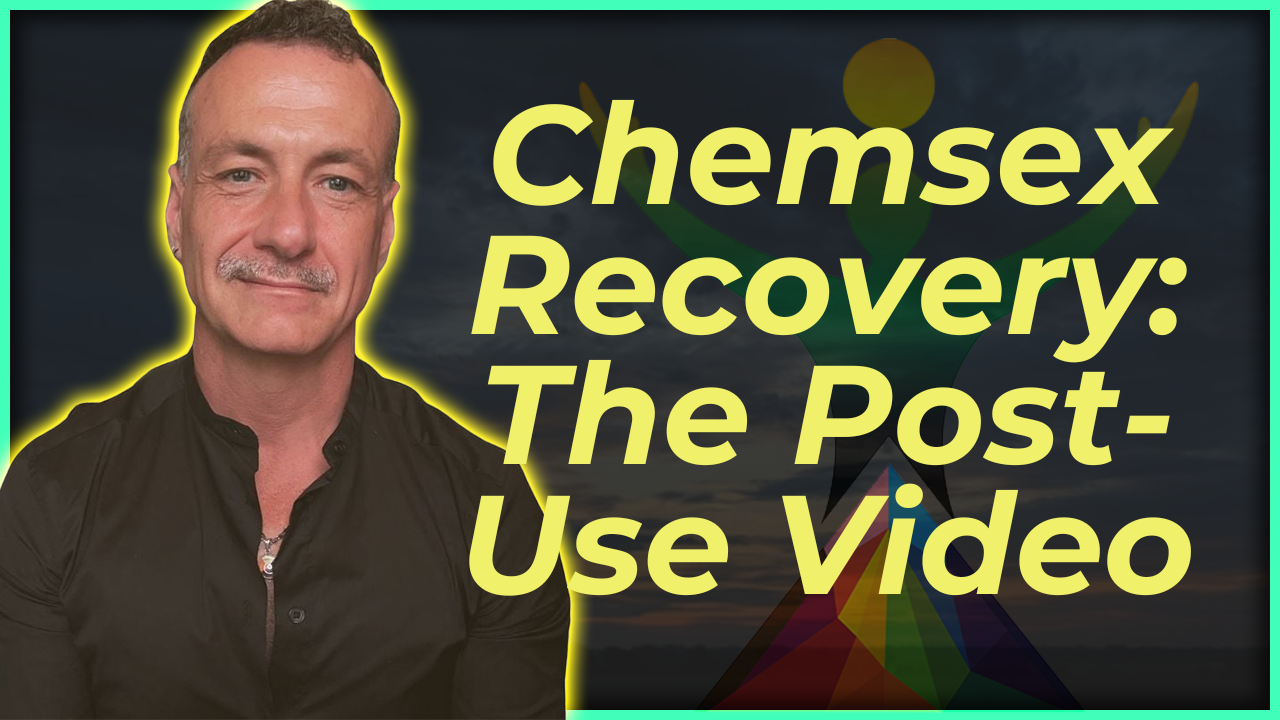
Damon Hunter is a former professor turned content creator, a licensed therapist, and a public health researcher whose work sits at the intersection of harm reduction and chemsex. He built his research career on harm reduction implementation science in rural areas and on rural queer health, and he was developing an NIH-funded chemsex harm reduction intervention before things shifted.
He also lived it. A country kid from an extremely religious household. Came out sophomore year of college. Said no to Tina the first time and yes about two weeks later. His use spiraled fast, and it cost him a federal charge, house arrest he kept using through, and eventually prison time. He has eleven years of abstinence from Tina now, and he is honest that there was a slip inside those eleven years.
This conversation holds two things at once, and that is exactly why it is worth studying. Damon is a harm reduction professional who believes it is not his business what anyone puts in their body, and he is a man who built a chemsex-free life on purpose, piece by piece, and can tell you exactly what the pieces were.
Part One: Harm Reduction, and Why It Matters Even If You Are Stopping
The words we use decide who gets help. Damon's content opens with cutting "methmouth" out of the vocabulary, and Dallas names something important: the men who throw around "tweaker," "meth head," and "crackhead" the loudest are often men who are not using anymore. That is not righteousness. That is unprocessed shame, still living in the body, pointed outward. Every time you call someone a name, you push them further from the door they might have walked through.
Guilt is useful. Shame is not. Damon draws a sharp line: "Can I maybe have guilt over the way that I treated some people in my life? Yeah, guilt is healthy. But shame does nothing for me. And it doesn't do anything for anybody else." Guilt is about what you did and it can be repaired. Shame is about who you are and it has no exit. If you cannot tell which one you are carrying, that is the first thing to look at.
Dental care is a luxury, not a virtue. Damon points out that his teeth held up because of genetics, parents who could get him to a dentist, and information he went looking for. Those are determinants of health, not moral character. Dallas adds the gallon jug of water he kept where he could not miss it. The point is not "use safely and you will be fine." The point is that outcomes are shaped by resources and access, and judging people for the outcome is judging them for the resources they never had.
Harm reduction is not permission. It is linkage. As Damon puts it, harm reduction gives a person someone who will help them with whatever their goal is, in a way that aligns with what they actually want, not what a provider thinks they should want. Dallas says the same thing from the coaching chair: giving someone respect and honoring their autonomy is what helps them come out of it when they are ready.
Know what exists, and know your state's laws. Drug checking with FTIR spectrometry, fentanyl test strips, naloxone, syringe services, and mobile delivery vans in rural areas are all real and increasingly available. Good Samaritan overdose laws exist in many states, which matters enormously for GHB, where someone going under needs medical care and the people around them need to not be afraid to call. In some states, including Illinois where Damon lives, getting drugs checked is explicitly not illegal. Look up what is true where you live. That knowledge protects you, and it protects the people you love who are still out there.
You may not be using, but people you love are. Damon has close friends who still actively use, and it works because the boundaries are explicit and there is a phone tree of about five people who would be on him if he ever asked. Knowing this material makes you useful to the people in your life who are still in it, without making you a threat to your own life.
Part Two: Building the Life That Holds You
Your secrets keep you sick. Damon has real critiques of twelve step programs and still gives that line its due. Whether it is meth, chemsex, or something you have never said out loud to anyone, telling one person is a pressure release valve. Dallas gets asked constantly what the first step is if you want to stop, and his answer is always the same: tell somebody. Tell the person who scares you the most. Damon says it about his younger self: if he could have told his best friend "I am trying this and I think I like it too much," a lot of missteps might have been avoided.
Community, not population. Dallas makes a distinction worth keeping. A queer community is a group you can be safe inside of. A queer population is just a demographic. Most men come out of chemsex knowing hundreds of queer men and belonging to none of them.
The number one tool Damon names is building a queer community. And here is why it works: the research and his own experience both say people in chemsex culture are looking for belonging, acceptance, and non-judgment. If that is what the scene is providing, then the thing that replaces it has to provide the same. Not a substitute activity. The same need, met better.
How he actually did it: he volunteered. Rural southern Illinois, no scene to speak of, so he signed up at the queer youth center a couple of Friday nights a month. He met other queer adults who were not on an app. He made some of his closest friendships there. He also met his husband there. Dallas gives the same advice to his clients constantly, and he means it literally: there is a queer nonprofit near you, wherever you are, and Grindr is not a representative sample of gay men.
Boredom is usually a vision problem. Dallas calls the space between the Tina life and the new life a liminal space, and describes men buffering and glitching inside it, saying "I am just so bored." Damon's read is that boredom means you do not yet have a strong enough picture of what your life could be. He also names why that is hard for queer men specifically: we grew up on stories where the gay character dies tragically. Nobody handed us a picture of a long, ordinary, good life. You have to build the picture yourself, by trial and error. Damon went through a baking phase, a sauerkraut and beet kvass fermenting phase, puzzles, crochet, cross stitch, and gardening. The question he kept asking was not "what will pass the time," it was "what will sustain me and contribute to the kind of person I want to be."
Keep your hands busy, and pick your goal. He had crochet hooks in rehab. He finished his bachelor's, then a master's in social work, then a PhD, and names education as a genuine safety net because it gave him goals to move toward. He is also honest about the drawbacks, including student debt and the fact that even social work programs are full of people who stigmatize the very people they serve. And on fitness, which many men reach for: it is a great goal, and watch that you do not walk straight from Tina into gear, peptides, or body dysmorphia. Your body is going to change after Tina. That is not a problem to solve with another substance.
One relationship you can be honest inside of. Damon's person was his former twelve step sponsor, a straight man, who left the program around the same time he did and wanted to actually understand party and play. He could text "my prescription ran out and I am nervous" and get a coffee. That man sent check-ins a couple times a week, not every day. Not surveillance. Contact.
On twelve step: take what is useful, leave the fear. Damon stays away from it and still says the free peer-based support it offers is genuinely valuable, and that in most places it is the only free support there is. His objection is the ideology, specifically the "your addiction is doing push-ups in the parking lot" framing. If you have to live permanently on guard, waiting for the thing that will drag you to a Motel 6 with a pipe in your hand, when do you get to live? Dallas connects it directly to Christian conditioning: the devil is always waiting, the monkey on your back, fear as a control mechanism. For queer men carrying religious trauma, walking into a meeting can feel like being thrust straight back into church. Damon's position is simple and fair: if it works for someone, great, just do not push it on other people.
The ADHD thread, handled carefully. What actually stopped Damon's use was not willpower and not a program. After antidepressants, mood stabilizers, and antipsychotics all failed, his psychiatrist asked whether he had ever been assessed for ADHD. He said no, he got straight A's, he was top of his class, he was on scholarship. She spoke to his mother and came back with: you were never diagnosed because you followed the rules and got good grades. He was scared of going to hell if he did not listen to his parents, so of course he followed the rules.
He is deliberately careful here, and so is this guide. The dose he was placed on for a period was above the indicated range, he says plainly that it is not a recommended treatment, and he warns that this cannot just be handed out. What he wants people to take from it is the question, not the prescription. Dallas is seeing the same pattern: more and more men discover ADHD during chemsex recovery, and it helps them turn a corner. If some part of your history rhymes with this, the action is to ask a prescriber for a proper assessment. It is not to self-diagnose and it is not to seek a specific medication.
And note what happened when he ran out of that medication during COVID shortages for a couple of months: he did not go looking for Tina, because by then he had built enough other supports that the tools held. The medication was never the whole structure.
Part Three: Sex, Pleasure, and Coming Back to Your Body
Pleasure is not a side issue. It is the center. Damon's critique of public health is that it is excellent at naming diseases, risk factors, and protective factors, and poor at recognizing anything good outside of health outcomes. "We need pleasure as humans, whether that pleasure is going on a walk by the beach or that pleasure is getting railed by ten guys in a dark room." You cannot separate pleasure from chemsex, and you cannot build a chemsex-free life that has no pleasure in it. That plan fails. It has always failed.
Celibacy chosen is different from celibacy feared. Dallas names men messaging him with fifteen years chemsex-free and fifteen years celibate, still afraid of sex. Damon is direct that it was never an option for him: "I like sex too much. I like my body too much. I like other people's bodies too much. And I can't deny myself of that." If you have chosen celibacy and it is nourishing you, good. If you are avoiding sex because you are afraid of what it will unlock, that is not a decision. That is a wound with a respectable name on it.
Reintegration is slow, and eleven years in it is still going. Damon says his sexual reintegration is ongoing. For a long stretch, sex was very vanilla, and that alone was hard enough. Then he hit a point where vanilla was not nurturing him and he wanted his kinks back. Leather, pig play, bathhouses, all of it had been fused to Tina.
The move that made it possible: a safe person and a plan. He told his husband ahead of time what he wanted, that it was tied to his use, and that he was nervous. The first bathhouse trip was planned in advance: stay near me, just you and me tonight, no one else. He decided in advance what he would do if he got overwhelmed, and it was not "leave." It was go to the locker room, take a shower, use the water temperature to regulate himself, and come back down. He never ended up needing it. Years later he walked into Steamworks Toronto alone and thought, holy hell, I can do this.
Notice that he went back to Club St. Louis, the same bathhouse where he first did Tina. Dallas calls it a calculated risk, and it is: a risk taken with conversations, plans, safeguards, and a person who knows.
The right check-in question. After, his husband asks: "Where are you at right now? Is there anything you need from me?" Not "are you okay." Not "are you triggered." Damon's line on that is worth memorizing: "I'm not responsible for anybody else's triggers, and you're not responsible for my triggers." Dallas adds the coaching piece: if your partner has no chemsex history, they want to help and they do not know how. It is your job to train them. Tell them the space you need. Tell them the exact question to ask.
This is consent practice. Damon is blunt that when we were partying, we were not good at consent, and that the research shows how blurry those boundaries got. Having explicit conversations about what might pull you toward using turns out to build the same muscle used everywhere else. Once you can say "this might trigger me into using," saying "you can slap me as hard as you want, but do not punch me in the face" is easy.
Screening, and the intuition that comes back. Early on, Damon screened everyone directly: are you partying? Yes meant no. Over time he could read it without asking, without a capital T in the profile. Dallas tells on himself here with the muscular thruple in the hotel room: delayed responses, strange spacing between letters, misspellings, and then "don't come up, we spilled water everywhere." He knew. He went anyway.
Two things are true. Screening is a real tool. And screening fails, sometimes because you overrode it yourself. When Damon shows up and there is a pipe out, he has a script: put that away while we do this, and afterward, if we do this again I would prefer you are not under the influence, and if you are, keep the paraphernalia out of sight. On the apps now he can answer "you party?" with "no, but stay safe and hydrated and enjoy yourself" and let the conversation end there, without blocking someone and without making them feel like garbage. He is clear that he could not do that in the early years. You do not have to be there yet.
Part Four: When the Safeguards Slip
Safeguards fail. That is information, not a verdict. Sometimes the safeguard needs revising. Sometimes there were other factors that made it impossible for that safeguard to work in that exact context.
A slip is not a reset. Damon says it plainly: "It's not a reset. I don't consider it that." He keeps his eleven years. Inside those years there was a night he was deeply suicidal and used with the intent of hurting himself, and he says it out loud in this episode so other men know it happens. He does not erase everything before that night because of it, and he does not think you should either. Dallas coaches the same math: if you used once at thirty days, you have thirty days and you used once in thirty days.
What he did next is the actual lesson. He called his person immediately and told him exactly what he needed: "I just did something really stupid. I just need you to provide support. I don't need anything else right now, just support and a listening ear. You can be mad about it. You have a right to be mad about it. But I can't have you be mad about it today." And his friend said: I am going to give you space, you know I am already mad, and we will handle that when you are in a different place. And they did. Like adults.
If you are the support person, this is your instruction. Support first. Save the lecture, save the "I told you so," save the anger, for later. And do not swallow it forever, because the person knows it is under the surface anyway, and holding it in helps no one. Damon names the consequence he had to sit with: someone he loves was hurt and disappointed in him. That is a consequence worth learning from, and learning from it means feeling it instead of running.
Watch the old mentality. Damon names it exactly: "You think I'm a tweaker? Let me show you what I can do." When you are hurt or ashamed or someone is disappointed in you, there is a part of you that would rather be the best damn tweaker they have ever seen than sit in the discomfort. Catch that voice. Name it out loud. That is the whole skill: handling conflict without needing a substance to escape it.
5 Reflective Questions
Take these slowly. There are no right answers, only honest ones.
- Where does your language about people who use drugs still carry contempt? When you hear yourself say tweaker, or methmouth, or "at least I was never that bad," what are you actually protecting yourself from feeling?
- Guilt or shame: which one are you carrying right now, and about what? Guilt says "I did something harmful and I can repair it." Shame says "I am the harm." Which voice has been running your recovery?
- Damon says the scene offered belonging, acceptance, and non-judgment. Which of those three did you get from chemsex that you are not getting anywhere else yet? Be specific, and be honest about the gap.
- If you are not having sex right now, is that a choice you made or a fear you are managing? What would have to be true for you to trust yourself in a sexual space again?
- Who is the one person you could call at three in the morning and say "I just did something I am not proud of, and I only need you to listen"? If nobody comes to mind, what has kept you from building that relationship?
5 Journal Prompts
Give yourself more space than feels comfortable. Let it be messy.
- Write the sentence you have never said out loud to anyone. Not for anyone else to read. Just get it out of your body and onto the page, and then write what you are afraid would happen if you said it to a person.
- Damon was never diagnosed with ADHD because he followed the rules and got good grades. What did you get praised for that let something real about you go unseen? Write about the cost of being the one who was fine.
- Picture your life five years from now, in detail, with no drugs in it. Where do you live, who is in the room, what do you do on a Saturday, who touches you, what are you proud of? If the picture is blank, write about the blankness. That blank is the boredom you keep describing.
- Write about a kink, a place, a song, or a room that is still fused to your use. What would it take to have it back on your own terms? What would the plan need to include, and who would need to be in it with you?
- Write a letter to the man who is still using and looks a lot like you did. No warnings, no scare tactics, no "I told you so." Just what you actually want him to know.
5 Action Exercises
Small, concrete practices. Pick one to start rather than all five.
- Tell one person one true thing this week. Not everything. One thing. Pick the smallest item on the list, not the hardest, and say it to a person who has earned it. Notice what your body does before, during, and after.
- Find the volunteer slot and sign up. Search for a queer nonprofit, youth center, community health org, or pride organization within driving distance and email them this week. Two Friday nights a month is enough. The goal is meeting queer people who are not on an app, and it only works if you actually put it on the calendar.
- Script your check-in question and hand it over. Write out the exact question you want your partner, friend, or support person to ask you after a hard moment. Damon's is "Where are you at right now? Is there anything you need from me?" Give them yours in writing. Do not make them guess.
- Build one safety plan before you need it. Pick a specific upcoming situation, a bathhouse, a hookup, a party, a trip, a family holiday, and write down four things in advance: who knows I am going, what my exit signal is, what I will do to regulate before I leave, and who I text afterward. Then actually use it.
- Learn your state's laws and get one supply. Look up your state's Good Samaritan overdose law and whether drug checking is legal where you live, then get naloxone and learn to use it. If you do not need it, someone in your life might, and knowing this is what lets you stay close to people who are still using without being a danger to yourself.
Going Deeper
Damon Hunter is on Instagram and TikTok at Damon Hunter X, where he makes harm reduction and chemsex content. His handle is in the show notes. Fair warning, and he says it himself, it is a page that is very open about sexuality, kink, and body hair alongside the public health material.
A few things from this episode worth looking up on your own: FTIR spectrometry and community drug checking, your state's Good Samaritan overdose law, naloxone access near you, and the work of Platteau on self-control and chemsex, which Damon expected to be bootstraps nonsense and found genuinely useful.
And if any of the ADHD material landed, the action is one phone call to a prescriber for a proper assessment. Not a search for a specific medication. Damon was careful about that for a reason.
You are allowed to want pleasure. You are allowed to want your body back. You are allowed to build the life slowly, one Friday night and one honest sentence at a time, and you are allowed to keep every day you have already earned. For coaching and more resources, visit www.recoveryalchemy.org.
Love you!! Dallas 💚

Responses