⚠️ Content Warning
This episode contains discussion of chemsex, substance use and addiction, sexual trauma, and topics related to sexual behavior and identity. Please care for yourself as you listen and engage with this material.
A Note from Dallas
I've been sitting with this episode since we finished recording it, and I keep coming back to a question I've asked myself a hundred times in recovery: Now what?
Getting chemsex-free is its own mountain. And then one day you wake up on the other side of it — maybe a few months in, maybe a year or two — and the mountain is behind you. And the view ahead is wide open and terrifying and full of possibility all at once. I've been there. I know what it feels like to not recognize the man looking back at you in the mirror. To have spent so long playing roles — in the closet, in the chemsex world, in early recovery — that you genuinely don't know what's underneath all of it.
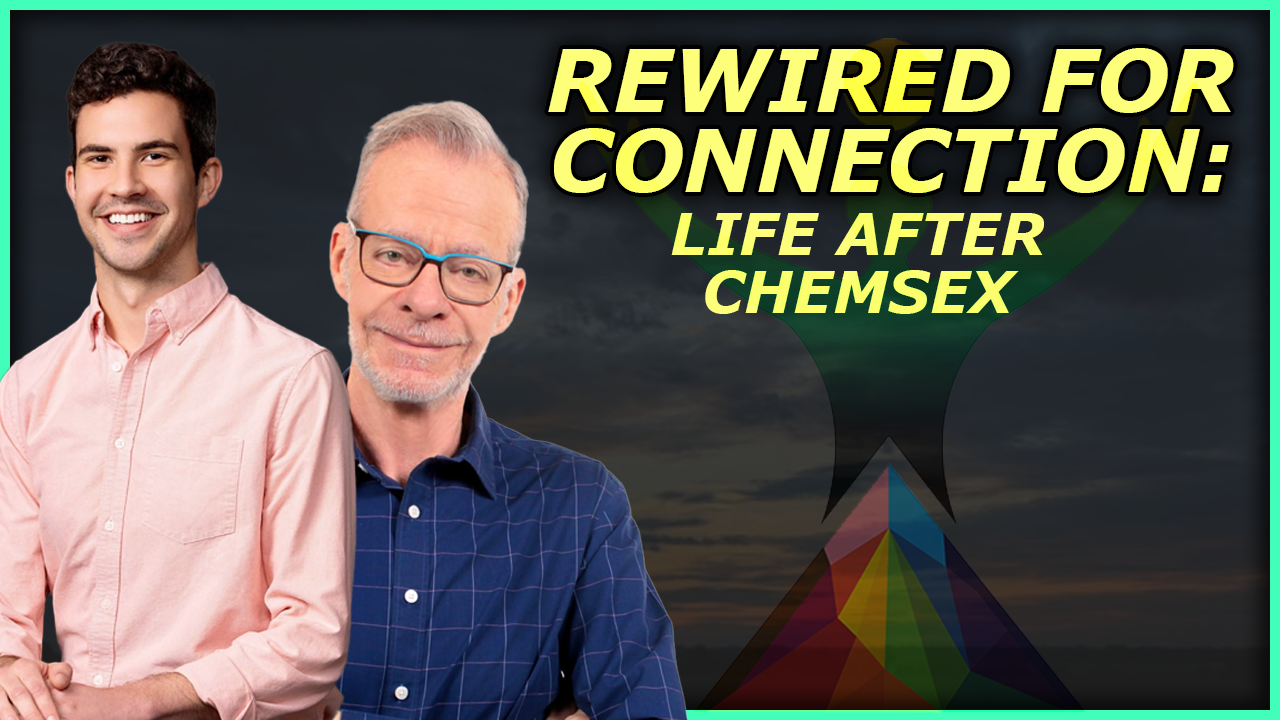
That's exactly the conversation I wanted to have in this episode. I brought together two people I deeply respect — Dr. David Fawcett and Andrew McDonnell — to talk about what it really means to rebuild a life, a sexual self, and an authentic identity after chemsex. And out of that conversation, something beautiful was born: a retreat. Rewired for Connection: Life After Chemsex. A four-day, limited-enrollment in-person experience in Florida designed for men who are ready to stop white-knuckling life and start actually living it.
But even if the retreat isn't for you right now, I want you to get something from this episode. Because the themes we explore — identity, intimacy, connection, sexual healing, and the courage to show up as yourself — those are for every man listening.
To apply for the retreat: https://www.recoveryalchemy.org/rewiredretreat
Let's dig in.
Love you, Dallas 💚
About the Guests
Dr. David Fawcett is a therapist and sex therapist with thirty years of experience working with gay men navigating chemsex recovery. He is the author of Lust, Men, and Meth and Sex Under the Influence, and recently co-authored the Lust, Men, and Meth Study Guide with Dallas. David has been a returning guest across multiple seasons of The AfterMeth Podcast and brings a deeply nuanced understanding of sexual reintegration, arousal, brain chemistry, and the cultural layers that shape gay men's relationship with intimacy.
Andrew McDonnell is a clinical social worker and outpatient therapist specializing in addiction treatment at a community mental health clinic in Memphis, Tennessee. He is also a person with lived experience of chemsex recovery. Andrew has collaborated with the London-based nonprofit Controlling Chemsex, where he co-facilitates a long-running virtual support group for men with problematic chemsex use. He brings Stoic philosophy, sexual ethics, and a grounded, courageous voice to his work with clients.
Theme 1: Life After Chemsex — The "Now What?" Question
One of the most honest things about this episode is how directly we name something that doesn't get talked about enough: recovery doesn't end when the drug use stops. For many men, the first stretch of being chemsex-free is about survival — avoiding triggers, building structure, hitting milestones. But somewhere in year two or three, the milestones slow down. The urgency fades. And what's left is the quieter, harder question: Who am I now, and where am I going?
Both David and Andrew described this turning point in their own recoveries. The supports that carried them through early recovery — meetings, structure, avoidance — started to feel like a ceiling rather than a floor. They needed something more nuanced: peers, role models, a container for deeper conversation. That hunger — for community that could hold the complexity of life after chemsex — is the exact gap this retreat is designed to fill.
Dallas reflected on his own experience of early recovery as a series of rapid milestones, each one bringing a shot of dopamine. New shoes. A car. A license. Graduating from drug court. And then the milestones ran out — and the deeper work of identity and purpose began. This is the work Rewired for Connection is built around.
If you're somewhere in this territory right now — chemsex-free but feeling unmoored — you're not doing it wrong. You're right on time.
Theme 2: Identity and the Authentic Self
A thread that ran through the entire conversation was the question of identity. Who were we before chemsex? Who did we pretend to be inside it? And who are we becoming now?
Dallas spoke about moving through multiple versions of himself — closeted for much of his life, then entering the gay community and still not quite landing in his own skin, then assuming a persona in the chemsex world that had very little to do with his true self. Coming out the other side meant confronting a blank page. The work of defining an ideal self — not a perfect self, but a North Star self — became foundational to his recovery and coaching practice.
David spoke powerfully about the messages gay men absorb from the world: bullying, discrimination, shame, internalized homophobia. These messages don't just wound — they teach us to live compartmentalized, to not take risks, to stay hidden. ChemSex can accelerate that compartmentalization and then strip it away, leaving us face to face with parts of ourselves we never examined.
The retreat's opening segment, led by Dallas, focuses entirely on this: defining your vision, identifying your limiting beliefs, and beginning to practice showing up as the person you are becoming.
You've spent long enough having your narrative written by the outside world. This is where you start writing your own.
Theme 3: Sexual Reintegration and the Arousal Template
David's clinical work over the last fifteen years has centered on what he calls sexual reintegration — the process of reclaiming (or in many cases, discovering for the first time) a healthy and satisfying sexual self after chemsex.
He explained how chemsex can fundamentally rewire our arousal template. The brain's dopamine system, flooded repeatedly with the high-intensity stimulation of chemsex, essentially recalibrates — raising the threshold for what registers as pleasurable or arousing. When a man becomes chemsex-free, it can feel like his sexuality has gone offline entirely. David was clear: this is not permanent damage. It is a neurological process, and there is a pathway through it.
The key insight David offered is counterintuitive: sexual reintegration doesn't start with sex. It starts with connection — a conversation, a coffee, a moment of real vulnerability with another human being. Learning to be present with another gay man without the currency of drugs or sex changes the brain, rebuilds the capacity for intimacy, and lays the groundwork for genuine sexual pleasure.
Andrew shared his own experience of navigating this process — slowly and intentionally reintroducing himself to arousal and physical closeness in stages, communicating clearly, titrating his reentry rather than diving back into intensity. The word he used was courage. It took more courage to be vulnerable face to face than it ever took to pursue sex in the chemsex world.
You are not broken. You are healing. And the path back to your sexuality runs straight through your humanity.
Theme 4: Connection, Intimacy, and the Power of Shared Container
A recurring theme across all three voices in this episode was the transformative power of being in the room — literally — with other gay men who understand.
Both David and Andrew described the limits of early recovery supports that, while invaluable, didn't fully address the specific contours of chemsex recovery: the sexual component, the cultural shame, the particular trauma of gay male experience. What was missing, they said, wasn't more meetings — it was peers. Men further along the road. A space to practice vulnerability without it turning into sex. A place to learn intimacy skills without the pressure of performance.
Dallas spoke about a particular kind of healing that happens when you can be around men and simply be — not evaluate, not sexualize, not fear. For many of us coming out of chemsex, other men have been simultaneously the source of our deepest connection and our deepest wound. Learning to rebuild that trust, in a safe and facilitated environment, is some of the most powerful work available.
David put it simply: the magic he's seen happen in group settings is almost impossible to replicate anywhere else. When men show up authentically, take small risks together, and are witnessed doing so — something shifts.
Just knowing that eleven other men in that room understand you? That alone can be sixty percent of the healing.
Theme 5: Stoic Philosophy, Sexual Ethics, and Social Reintegration
Andrew brought two frameworks to this conversation that are quietly radical in a recovery context: Stoic philosophy and sexual ethics.
He described Stoicism not as emotional suppression but as a philosophy of process — closely related, he said, to the spirit of the Serenity Prayer. It's about noticing what comes up when you step into uncomfortable territory, resisting complete collapse, and building what the Stoics call the inner citadel: resilience earned through experience. For men trying to re-enter social situations, dating, or community after chemsex, this philosophy offers something practical: you don't need a magic formula. You need a willingness to walk into the discomfort and stay.
On sexual ethics, Andrew pushed back gently on the idea that having a thoughtful ethical framework around sex means taming it. It doesn't. His point — and Dallas echoed it emphatically — is that men with clear values around sex often have better sex. Knowing what you want, what you're willing to do, and how you want to treat the people you're with doesn't constrain pleasure; it creates the conditions for it.
He also named something many of us feel but rarely say out loud: gay sexual culture can be normless in ways that leave us disheartened. The apps have replaced the bars and the cruising grounds and the codes of an earlier era, and in doing so they've stripped away some of the social scaffolding. Learning to connect — face to face, authentically, with or without the apps — is a skill that has to be actively rebuilt.
Ethical doesn't mean vanilla. It means knowing who you are and showing up that way — in every room, including that one.
Closing Reflection
I want to leave you with something David said near the end of this conversation, because it has stayed with me:
Think of a film that profoundly affected you. It probably dealt with something existential. It stayed with you long after you walked out of the theater.
That's what we're trying to create at Rewired for Connection — an experience that stays in your body. Not a handbook you throw away at the airport. A real shift.
But you don't have to be at the retreat to begin. The questions in this guide are an invitation to start the work right now. In your journal, in a conversation with a trusted friend, in a quiet moment with yourself.
You are not the person chemsex made you. You are not even the person you were before it. You are someone new — and you get to decide who that is.
Reflective Questions
-
When you imagine life fully on the other side of chemsex — not just "not using," but genuinely thriving — what does that look like? What's one specific thing you can see clearly in that picture?
-
David described how many gay men come out of chemsex never having truly discovered their sexuality — only having had it shaped by external forces. How much of your sexual self feels like yours? How much feels like it was handed to you?
-
Andrew described the courage it took to step into social situations that might be triggering and stay present rather than escape. Where in your life right now are you being asked to do the same kind of thing?
-
Dallas talked about the loneliness of early recovery — finding community outside traditional spaces, learning to be around other men without the familiar scripts. Where do you currently find authentic connection? Where is it still missing?
-
All three guests spoke about the gap between early recovery and living a full life in recovery. Where do you feel yourself in that arc right now? What does the next chapter look like, and what would it mean to step into it?
Journal Prompts
-
Write about a version of yourself you performed in the chemsex world. Who were you pretending to be? What were you hiding underneath it? What's it been like to shed that persona — or are you still in the process of shedding it?
-
David said that for him, being truly seen by another person — showing up as a human being in front of another human being — was far more frightening than sex. What does it feel like for you to be seen? Write about a moment when someone saw you clearly and it felt safe. What made it safe?
-
If you were to describe your "North Star self" — not who you think you should be, but the fullest, most authentic version of who you are becoming — what would that person look like? How do they carry themselves? What do they value? What are they no longer carrying?
-
Andrew talked about titrating his return to intimacy — taking it slowly, communicating clearly, honoring where he actually was rather than where he thought he should be. Write about where you currently are in your own process of rebuilding intimacy (physical, emotional, or both). What would one honest, small next step look like?
-
Reflect on the concept of an "inner citadel" — a strength built through experience, through showing up and not collapsing, again and again. Where have you already built this in your recovery, even without naming it? What adversity did you face that quietly made you stronger?
Action Exercises
-
Define your North Star. Spend 20 minutes writing a first-person description of your ideal self — not a perfect self, but a clear self. How do you show up in the world? What do you value? How do you treat people? How do you feel in your body? Keep it somewhere you'll see it daily. Dallas calls this casting a vote for the person you're becoming.
-
Map one limiting belief. Identify one belief you carry about yourself — about your worth, your desirability, your ability to be loved — that you suspect was handed to you rather than chosen by you. Write down where you think it came from. Then write a single sentence that challenges it. You don't have to believe the new sentence yet. Just write it.
-
Practice face-to-face connection. Reach out to one person in your life this week and suggest a conversation — coffee, a walk, a call — with no agenda other than honest connection. If that feels scary, notice the fear without letting it make the decision. Andrew called this "leaning into discomfort." Try it once.
-
Begin a personal sexual ethics inventory. This isn't about restriction — it's about clarity. Write down three values you want to guide your sexual life going forward. What do you want to feel when you walk away from a sexual encounter? What behaviors feel aligned with the person you're becoming? What doesn't? You don't have to share this with anyone. It's yours.
-
Explore one resource from this episode. Visit the Rewired for Connection retreat page (link in show notes), look into Controlling Chemsex if you need free support, or pick up a copy of Lust, Men, and Meth or Sex Under the Influence by Dr. David Fawcett. Take one concrete step toward the support or knowledge you're missing. (Please verify all links before publishing.)

Responses