Content Warning
This episode and study guide discuss sexualized drug use (chemsex), methamphetamine and other substance use, sex work, HIV and STI risk, overdose, body image and eating disorders, gender dysphoria, and experiences of stigma within the recovery and healthcare systems. Some of this material may be activating, especially if you are early in your own process or navigating a difficult stretch. Move through this guide at your own pace. Skip what you need to skip. Come back when you're ready.
The views shared by the host and guest are not medical advice.
A Personal Note from Dallas
For a long time I've wanted to bring you an episode that sits honestly in the middle of the spectrum — not at the abstinence end, not at the active-use end, but in the wide, real territory in between where most people actually live.
I present all sides of recovery on this show because I believe you deserve the full picture, not just the version that's easiest to market. Harm reduction is one of the most researched, most life-saving approaches we have for long-term chemsex recovery, and yet it's one of the most misunderstood. If you've tried to stop and it hasn't held, if you've cycled through programs and been made to feel like a failure every time, I want you to hear this conversation without the shame attached to it.
You are the executive of your own recovery. My hope is that this episode hands you a little more information, a little more agency, and a lot less judgment.
Love you, Dallas 💚
Guest Bio
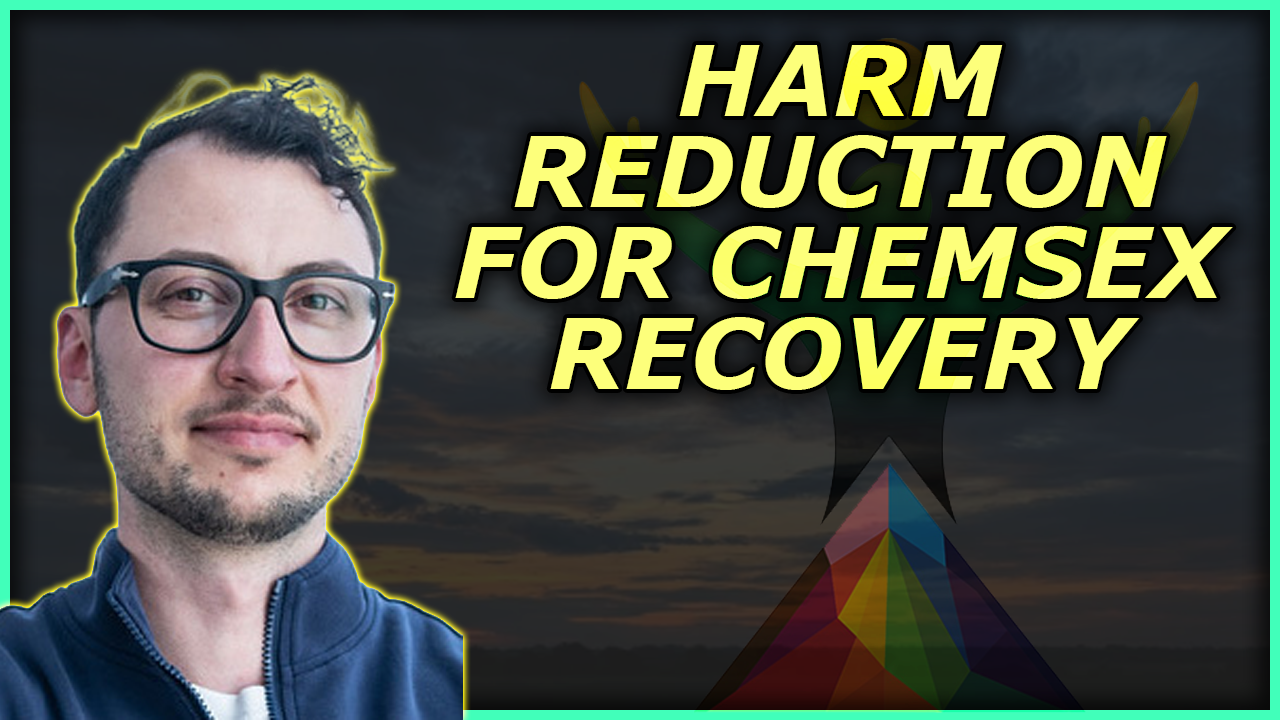
Taylor Edelmann is a harm reduction consultant and healthcare compliance officer, and the founder of the consulting practice Needle in the Hey!. Taylor has practiced harm reduction for over a decade, with work centered on gender-affirming care, health equity, and organizational development.
Taylor previously worked at the National Harm Reduction Coalition, overseeing a program focused on queer and trans people who use drugs and engage in sex work, and continues to consult with harm reduction and recovery organizations looking to strengthen their practice. A central theme of Taylor's work is the idea that harm reduction and gender-affirming care are "braided" movements, both grounded in the framework of bodily autonomy.
Section One: What Harm Reduction Actually Is
One of the most important things this conversation does is clear up a misconception: harm reduction is not the opposite of abstinence. It's a spectrum that runs from active use to abstinence, with everything in between — tapering, planned use, managed use, and yes, full abstinence, all folded into the same continuum.
Taylor describes harm reductionists as pragmatists and realists, not people who are oblivious to risk. The framework openly accepts that substances carry both risks and benefits, and that drugs have always been part of human life and always will be. From that starting point, the question shifts. Instead of "how do we make you stop," it becomes "if you are going to use, how do you do it in a way that keeps you alive and as healthy as possible."
This reframing matters because so much of traditional recovery culture treats abstinence as the only legitimate outcome. When abstinence is presented as the single acceptable goal, everything else gets branded as failure. Harm reduction refuses that binary. It says there is a place for abstinence, and there is a place for managed use, and the person living the life gets to decide which one fits.
If you've felt like you don't belong in recovery because you can't or don't want to commit to never using again, this section is worth sitting with. You may simply need a different door into the same house.
Section Two: Shame, Stigma, and Why Silence Kills
A theme running underneath this entire episode is shame — how it's manufactured, how it isolates, and how it drives the very behavior it claims to correct.
Taylor and Dallas are direct about the mechanics of it. When someone is shamed, shut out, or lectured for using, the most common result is that they use more and disclose less. Shame is often what got a person to a painful place to begin with, so piling on more shame rarely produces change; it produces secrecy. People suffer in silence, and silence is where the danger lives.
For queer and trans people, this dynamic is intensified by layers that aren't always visible from the outside. The minority stress model — originally developed to describe the experience of gay and bisexual men — names the reality that structural, interpersonal, and individual stressors accumulate over time. When the external world becomes more hostile, and when programs and providers close their doors or refuse to name certain kinds of care, people are left with nowhere to bring their full selves. That pain often turns inward, and substances can become the outlet.
None of this is an argument that using is shameful or shameless in the abstract. The point is subtler: judgment doesn't heal, and it frequently makes things more dangerous. A space free of judgment is not permissiveness. It's the precondition for honesty, and honesty is where safety begins.
Section Three: The Gap in Treatment and the Cost of Cookie-Cutter Care
This episode is honest about a hard truth: for chemsex specifically, the treatment landscape has real gaps.
Taylor describes years spent inside harm reduction programs that were built around cocaine, crack, and opioids, where meth, GHB, ketamine, and MDMA barely registered — and where chemsex, the fusion of drugs and sex, wasn't part of the conversation at all. Even well-meaning providers often lacked the vocabulary and the "drug IQ" to engage with what queer and trans clients were actually experiencing. Taylor recalls a period working in HIV case management where clients simply didn't have language for what was happening to them, and the referral book came up empty when someone finally asked for help.
Both Dallas and Taylor also name the limits of the dominant abstinence-based, insurance-funded model. It can be expensive, inaccessible, and built around rigid timelines — better in fifteen days, thirty days, ninety days — that don't match how change actually happens. Treatment also tends to happen in an environment removed from a person's real life. You can get momentum inside a center, but the triggers, relationships, and phone are all still waiting when you go home.
The takeaway isn't that treatment centers are worthless. It's that a single cookie-cutter framework can't serve everyone, and that we need honesty about how genuinely hard this is — plus transitional and ongoing support for the difficult stretch after formal treatment ends.
Section Four: Agency, Planned Use, and Building the Muscle of Choice
One of the most practical threads in this episode is the idea that structure and self-trust can be built deliberately, like a muscle.
Taylor and Dallas describe a managed-use approach where someone builds time, notices they feel clearer and stronger, and starts extending the gap between uses. When use does happen, it's structured: a chosen day, a set amount, a defined stopping point. Dallas describes setting up a small menu of metrics — say, ten things — and treating it as a real success if someone meets six or seven of them. That's cause for celebration, not a reason to declare failure.
What grows out of this is agency. As a person takes charge of their own use, their trust in themselves grows, their confidence grows, and they begin to internalize the idea that they can say no, and that they can decide when and whether to use at all. Counterintuitively, that sense of control is often what helps someone move toward using less or stopping.
There's also a sharp observation buried here: many people who keep relapsing against an abstinence plan are already planning their use — just subconsciously, in a way that controls them. Bringing that planning into the open, and putting the person in the driver's seat, can transform something that feels powerless and unmanageable into something they actually direct.
Section Five: Talking to Your Provider — Using Your Voice as Medicine
The episode features a campaign clip aimed at healthcare providers, and the guidance in it doubles as a script you can use as a patient.
The core message is that chemsex shows up in exam rooms constantly and almost never gets asked about well — and when it does, it's often reduced to a yes-or-no question. That matters because chemsex carries real, specific health implications: overdose risk, HIV and STI exposure, mental health impacts, and medication-interaction dangers that many providers don't even consider. Certain HIV medications, benzodiazepines, and sleep aids can interact badly with chemsex drugs, and substances like GHB can raise the stakes further. Consistency with PrEP and ongoing treatment can also be harder to maintain.
Here's the part to hold onto: providers usually won't get this information unless a patient feels safe enough to share it, and many patients have learned to keep it to themselves after being judged or shut down. But your life can be at stake in that room. That gives you a reason to use your agency — to make sure your provider understands exactly what has been in your body, what you've been doing, and when you last slept.
Two practical moves come out of this. First, specificity helps: saying "I use meth" isn't the same as naming the fusion of drugs and sex, and the more precise you are, the better the care. Second, safety practices are worth building into your life regardless of where you are on the spectrum — testing your substances, knowing about drug-spotting services, and making sure naloxone is on hand and that the people around you know how to use it.
Closing Reflection
If there's one invitation to carry out of this episode, it's this: be the executive of your own recovery. Stop measuring yourself against everyone else's timeline and everyone else's badge, and look honestly at what actually resonates with you and your body.
Maybe that's abstinence. Maybe that's a managed-use plan with a harm reduction therapist. Maybe it's simply asking one better question at your next medical appointment. All of it counts. And more people are walking this middle path than you'd ever guess from the noise online — it's just rarely spoken about out loud.
Wherever you are on the spectrum today, you deserve information without shame, support without judgment, and the dignity of making your own informed choices.
For coaching, resources, and more on chemsex-free living and recovery, visit www.recoveryalchemy.org.
Love you, Dallas 💚
Five Reflective Questions
-
When you imagine "recovery," whose definition are you using — your own, or one you inherited from a program, a family member, or the culture around you? What would it mean to define it for yourself?
-
Where in your story has shame made you go quiet? What did that silence cost you, and what might change if you brought one piece of it into the light?
-
Taylor describes harm reduction as a spectrum from active use to abstinence. Where do you honestly locate yourself on that spectrum right now — not where you think you should be, but where you actually are?
-
If you keep making the same plan and it keeps not holding, what might that be telling you about the plan rather than about you?
-
Think about the last time you sat across from a healthcare provider. Did you tell them the whole truth? If not, what would you have needed from them — or from yourself — to be able to?
Five Journal Prompts
-
Write about a time you were judged or shamed around your substance use or your identity. How did it affect what you did next? Then write the response you wish you'd received instead.
-
Describe your ideal "buffet" of recovery — the full plate of options you'd want available to you, without anyone telling you what you're allowed to choose.
-
If you were to design a managed-use or safety plan for yourself, what would be on your list of ten? Be specific and honest about what feels realistic.
-
Write a letter to a healthcare provider you've seen — one you'll never send — telling them everything you held back. Notice what comes up as you write it.
-
What does "agency" mean to you right now? Describe one area of your life where you feel powerless, and one small place where you could reclaim a sense of choice.
Five Action Exercises
-
Locate the principles. Look up the National Harm Reduction Coalition's principles of harm reduction and read them slowly. Note which ones resonate and which ones you resist — both reactions are information.
-
Build your ten. Draft a personal set of ten metrics for a two-to-three-week stretch (these might touch on use, sleep, connection, movement, or anything that matters to you). Decide in advance what number counts as a win, and plan to celebrate it.
-
Write your provider script. Prepare two or three sentences you could actually say to a healthcare provider about what's been in your body and what you've been doing. Practice saying them out loud until they feel less heavy.
-
Assemble a safety layer. Identify one concrete safety step you can take this week — locating naloxone, learning how to use it, teaching someone close to you, or looking into a drug-spotting service — and take it.
-
Do your own research. Spend twenty minutes looking up peer-reviewed research on chemsex or harm reduction (Google Scholar is a good starting point). Practice being the executive of your own recovery by forming your own view rather than adopting someone else's.

Responses