Content Warning: This episode and study guide discuss chemsex, methamphetamine and other substance use, injection drug use, HIV and the death of a partner, grief, sex work, childhood neglect, thoughts of not wanting to be alive, and hookup-app use. Please move through this material at your own pace. If something here stirs you up, that is not a signal to push harder — it may be a signal to pause, breathe, and reach out. Nothing here is medical or clinical advice.
What This Episode Is About
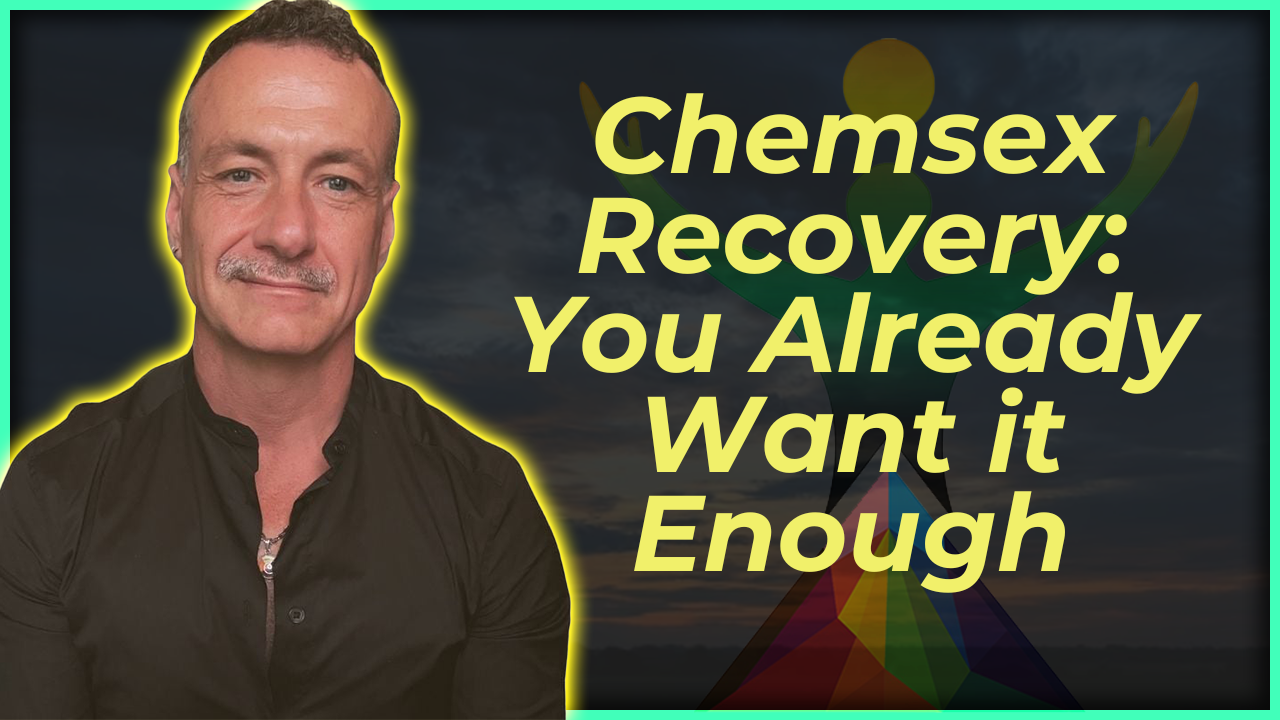
Danni Pomplun is a men's coach and men's work facilitator in San Francisco with a background in yoga and mindfulness — and before that, ten years managing gay bars and nightclubs. He came to this work the hard way: losing his first love to AIDS at twenty-five, waking up two days later with someone slamming him and no memory of how he got there, and then, years later after a long stretch away from drugs, going from almost no meth history to shooting up three or four nights a week in six weeks.
What makes this conversation matter is what he says about the part nobody prepares you for. Quitting is not the finish line. As Danni puts it in one of his reels, the hard work comes after you stop the substance. Dallas says the same thing in his own words: quitting meth is the easy part — now you roll your sleeves up.
The core of this episode is that you cannot think your way out of this. Danni spent years in talk therapy and calls it valuable — and says it got him only so far, because it stayed "all mental and cerebral, front cortex thinking, thinking, thinking." For someone with an addiction, more thinking is not the medicine. What finally moved him was letting the emotion move through his body, in a room with other men, out loud.
Key Ideas to Sit With
The real work starts after you stop. Removing the substance clears the room. It doesn't furnish it. What comes next — feeling, expressing, connecting, being touched, being witnessed — is the actual recovery. Without it, you are white-knuckling.
Freedom without containment becomes leaky energy. Danni loves what's liberating about being a gay man: freedom in sexuality, expression, and life. He also names the cost of no boundaries around any of it. He describes two forces — structure and flow, what holds the thing and what expresses the thing — and says our community is enormously good at expression and short on containment. Naming this isn't being a buzzkill. It's asking what holds you.
Sharp love is love. In men's circles, Danni got something he'd never gotten in the gay community: someone calling him on his integrity. He tells the story of walking up to the mic to talk about his ex again and his teacher saying, Sit down. We don't want to hear it. You said you'd do something and you didn't. His first reaction was rage. The gift was that he wasn't allowed to repeat the pattern in real time.
Talk therapy plus embodiment. Danni is generous about talk therapy — he says if someone who talks to no one started talking to a light pole every day, we'd be in a better place. And: emotion is energy in motion, and it needs to move through the body. In a facilitated practice, he went back to his partner's death expecting sadness and found rage. Two men held him back while he screamed at the man who left him. The tears came after. He describes feeling millions of pounds lighter, and that's the day that put him in this work.
Unspoken conversations are a trigger. Dallas names something he's seeing in his clients: the buildup of things never said. A man faces people at work who are causing him great stress, says nothing, day after day, and the pressure has nowhere to go — until it goes into chemsex. Meth gives a temporary numbness and a break from it. If you only look at the apps and the sex, you miss why he was on there in the first place.
Language is the barrier. If something is on fire inside you and you don't have the word anxiety, you'll call it a sexual charge — and act accordingly. Danni credits Brené Brown's Atlas of the Heart for giving him language for his own experience. Nobody taught most of us the emotion wheel. Geometry, yes. That, no.
Two things men can't feel: grief and celebration. Grief we understand. Celebration is the surprise. Danni says men have a hard time finding joy and celebrating themselves — afraid it reads as bragging — so we breeze past our own progress and go straight to hunting for the next thing. Pausing to see how far you've come does something to your self-trust.
Count what you did, not what you lost. Dallas doesn't reset a man to day one. If you used once at thirty days, you have thirty days and you used once in thirty days. The habit of discounting one hundred percent of what you've done because of the "yeah, but I also did that" is its own kind of harm.
The body is talking. Danni describes checking in with three places daily — the head (analytical), the heart (emotional), and the gut (the physical being) — and says he never needs to ask his head anything, it's yelling all day. He asks his heart and his body what's in there. These bodies are older than we are and they send signals constantly, if we know how to listen. Most of us weren't taught to be in our bodies. We were taught to shame them or change them.
Watch the moment you exit. The exit is the moment reality gets a little too much and you leave yourself. Danni had a rejection wound, and when he felt rejected he immediately reached for something — usually the phone, usually to be reminded he was wanted. The practice isn't to stop having the feeling. It's to catch the reach and stay with what's underneath it.
Touch is a need, not a want. In one circle, men were asked how they wanted to receive love from other men — massage, words of affirmation, or simply sitting together. Every single person chose touch. For men coming out of chemsex, being touched — without it becoming sexual, without bracing for it — can be one of the hardest and most healing things there is. Dallas is honest that after meth, he could give but not receive for a very long time.
Community care, not just self-care. Self-care is a piece of the puzzle, not the puzzle. Danni closes with this: reaching out to your community for support is one hundred percent okay — and really, who are you not to let your friends help? "It's amazing that we get to laugh and dance together. It's a shame if I don't get to see you cry. I want to experience all of you."
You do not have to do this alone. Danni's message to men using today is worth reading twice: I get it. It is hard out there sometimes. It is sad out there sometimes. I want to be loved just as much. And you do not have to go through that experience alone.
5 Reflective Questions
Take these slowly. There are no right answers — only honest ones.
- Where in your life is there full expression with no containment? Not to shame it — to look at it. What would healthy structure around that part of your life actually look like, chosen by you?
- Danni got sharp love — someone who told him the truth instead of letting him repeat himself. Who in your life is allowed to do that with you? If the answer is nobody, what would it cost you to give someone that permission?
- What conversation are you not having right now? Who is it with, and what has the pressure of not having it been costing you?
- When you feel rejected, what is your first reach — the phone, the apps, food, work, a substance? Try to name the exact moment you exit yourself.
- When was the last time you let someone celebrate you, and what happened in your body when they did? Where did you learn that taking the win was bragging?
5 Journal Prompts
Give yourself space and write longer than feels comfortable. Let it be messy.
- Danni thought he was sad about his partner's death and found rage underneath it. Pick a loss you believe you've already processed. Write about it as if you're allowed to be furious. See what's actually there.
- Write the conversation you've been avoiding, in full — everything you would say if there were no consequences and no one interrupted you. Nobody has to read it.
- Danni says he "didn't come online" until he was thirty — that he'd never felt his own emotions or had genuine connection outside a bar. When did you come online, or have you yet? What did you miss while you were away, and what are you learning now that most people learned earlier?
- Make a list of everything you have done since you started moving toward a chemsex-free life — including the things you usually erase with "yeah, but I also…". Then write one paragraph to yourself with the "yeah, buts" deleted.
- Danni says he built what he didn't have. What didn't you have? Write about what you would build for the man who is where you were two years ago.
5 Action Exercises
Small, concrete practices. Pick one to start rather than all five.
- Do a three-place check-in. Once a day for a week, put a hand on your chest and ask your heart what it has for you, then drop your attention to your gut and ask your body what's in there. Write down the answer without editing it. Your head does not get a turn.
- Get the language. Find an emotion wheel, or work through a section of Atlas of the Heart, and name what you're feeling with more precision than "fine," "stressed," or "horny" for seven days. Notice how often the accurate word changes what you do next.
- Have one unspoken conversation. Choose the smallest one on your list — not the hardest. Say the true thing to the person it belongs to, or to a coach or a brother if that's the safer first step. Notice what your body does before, during, and after.
- Move the emotion, don't just discuss it. Once this week, do something that puts feeling into your body rather than your head: breath work, a dance in your kitchen, a long walk with the music off, sound, shaking it out. Ten minutes counts. The goal is movement, not insight.
- Ask for touch, out loud. Text one safe friend and ask for a hug, a hand to hold, or time sitting shoulder to shoulder — and say plainly that it isn't sexual, it's connection. If that's too much right now, start with a men's circle or group where being witnessed is the point, and let it be one step at a time.
Going Deeper
Danni works with men through online men's circles that are free or donation-based — no one is turned away for lack of funds — as well as in-person experiences and one-on-one coaching. Each circle typically includes breath work, some form of embodiment, a teaching, and space for men to support men. He also has a free meditation album, From Pain to Peace, built around what he needed to hear in grief, in loneliness, and when coming back to his body. His links are in the show notes.
If some of the language in this episode was new to you — somatic, embodiment, containment, masculine and feminine as structure and flow — it's worth looking those up and sitting with them. This is an episode to listen to more than once.
You do not have to do this alone, and you were never meant to. Take the win, tell the truth, move the feeling, and let someone hold you. For coaching and more resources, visit www.recoveryalchemy.org.
Love you!! Dallas 💚

Responses