

A Part of Me
Phone in my left hand. Thumb scrolling Grindr. Cigarette in my right hand. Both feet up on the patio banister.
It was a bright Saturday afternoon, and I was having a conversation with a guy about parTy-ing. I was doing the math in my head. Saturday night into Sunday morning, then rest, then ready for work. I could make it work.
One voice said go for it.
Another voice, a part of me, said this is not who you are. You're gonna lock yourself in your room with this guy, who could be in psychosis or look totally different than his pics, for forty-eight hours and regret this on Monday. Go hiking. Call a friend. Do something that doesn't leave you broken on a weekday.
Not knowing which voice to listen to, I thought, let me look at his dick pics. That'll help me decide.
So I kept listening. Two different voices. Two different parts. And as I was thinking through it, I looked up from his portfolio of nudes.
If part of me wants to use and part of me doesn't want to use, then who am I? Who is the person observing these two voices? Who is watching the two parts?
That was one of many spiritual epiphanies I had during my use, moments I pulled on in early recovery.
And in early recovery, I learned about parts integration. That's what I want to share with you today.
Working with the part of me who wants to use meth revolutionized my recovery and helped me develop spiritually. It also alleviated a ton of shame that I had developed sitting in a circle introducing myself as "an addict."
My soul self is not an addict. Couldn't be. However, part of me had addictive patterns associated with chemsex. A part of me who I created, programmed and nurtured.
Once I got to know him, I knew myself on a deeper level, and my entire life became brighter, more open, and whole.
So, I tell my clients that I do not want to hear "I want to use" or "I have a craving." Instead, we say "A part of me wants to use" or "A part of me is experiencing a craving."
This allows you to begin a dialogue with that part and separate your identity from the behavior.
How to Dialogue with This Part
Once you've named it, you can go deeper. You can actually have a conversation with this part.
The first method is personification.
Ask yourself: What does this part look like? Does it have a shape, a color, a texture? An age? Some men see it as a shadow. Some see it as a younger version of themselves. Some see it as something protective, like armor. Some see it as something hungry. Don't overthink it. The image that comes is the right image.
Once you see it, give it a name. Try not to give it an evil name like Tina the bitch or the devil. Just a word or name that would describe its essence.
Now you can ask it questions. What do you want? What are you protecting me from? What were you programmed to do, and why did that make sense then?
The second method is the letter. You write to this part. You ask it directly: What is it that you really want? Because it's not meth. Meth is the delivery system. It's the vehicle. But underneath that, your part wants something real. Safety. Connection. Numbness. Pleasure. Power. Visibility. Rest.
Write the questions down. Then allow the part to answer. Use your nondominant hand if you can. There's something about crossing that threshold into the other side of your brain that lets the answers come more freely. Write what this part wants to tell you.
Then write back. You're having a conversation on the page. A letter to this part. A letter from this part. Back and forth until you understand.
The third method is the meditative ask. You don't write. You sit. You ask the question in your mind: What is it that you want? What do you need? And then you wait. You stay in that quiet, receptive state. The answer will come. Sometimes it's a word. Sometimes it's an image. Sometimes it's a feeling you didn't have words for before.
All three methods are doing the same work. They're turning a craving into a conversation. They're turning fragmentation into listening.
What You Say After "I Am"
This matters more than you might think.
When you say "a part of me wants to use," you're telling yourself the truth. When you say "I'm having a craving," you're still separating yourself from it.
But when you say "I'm an addict" or "I'm an alcoholic," you've just made that part your whole identity. You've made it permanent. You've made it a life sentence.
Your soul self, your truest light, is not an addict. It never was. It doesn't want to use. It can't want to use, because that's not what it is.
But every time you sit in a room and say those words, every time you repeat them, you're programming yourself deeper into that identity. You're telling your nervous system, your subconscious mind, your whole being: this is what you are. This is permanent. This is who you'll always be.
That's why the language matters. That's why "a part of me" changes everything. Because it keeps your true self intact. It keeps the door open. It keeps you free.
Integrating the Two Parts
So there are two parts: one who wants to use and one who doesn't want to use. Neither are you. Now you get to be the mediator.
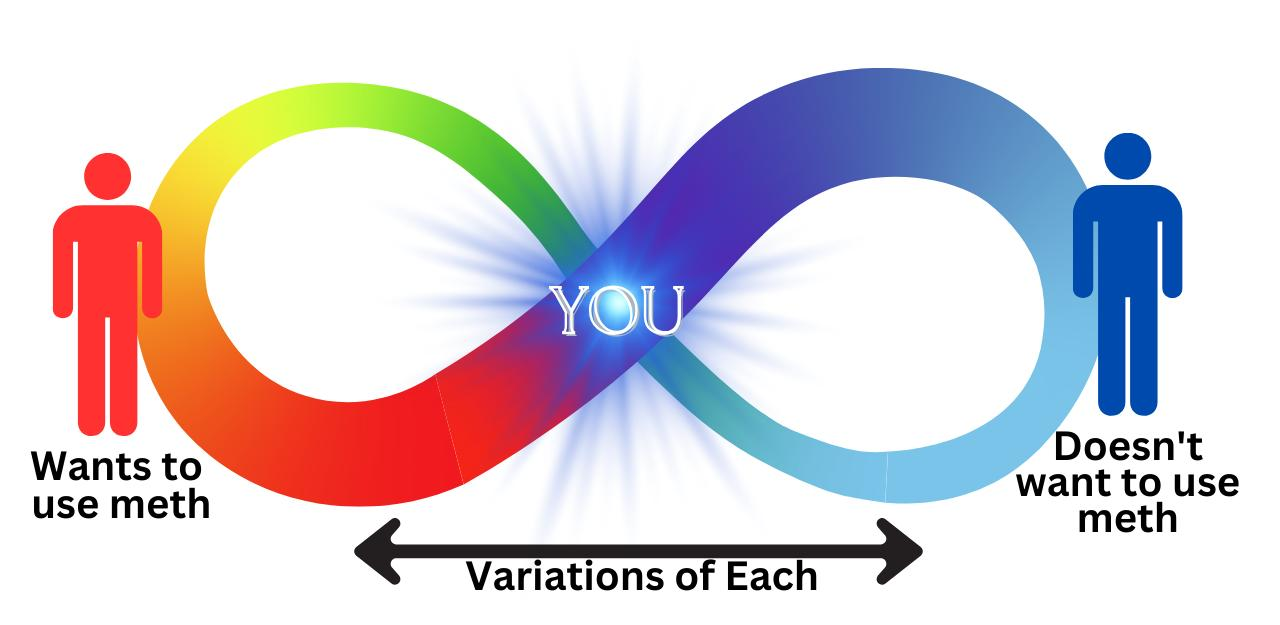
Picture an infinity symbol. Your soul self sits in the center, watching. On one side, the part that wants to use. On the other, the part that doesn't. Both were formed from the conditioning of your life. Both are trying to protect you.
And when you're not connected to your center, they pull you back and forth along that loop. Some men stop using and stay stuck in that loop for years.
So you don't pick a side. You get curious about both.
Let me show you what this looks like with a real client. He gave me permission to share his work.
You'll find the link to a worksheet for this practice below. You're going to ask each part a question and then integrate the answers so that both sides get what they want and you are finally in control of your life's direction.
Core Belief
The part that wants to use: "We love the euphoric and naughty sex on meth."
The part that doesn't want to use: "The connectedness and chemistry of sober sex is way more powerful and fulfilling."
Look at what both parts are actually saying. Neither one is wrong. One wants euphoria. One wants connection. They're not enemies. They're both pointing at the same thing from different sides.
Integrated belief: "Sober, connected sex can be euphoric and naughty."
That's the whole fight, resolved in one sentence. Nothing got eliminated. Both parts got what they asked for.
Method
The part that wants to use: "Continuously pitching ideas."
The part that doesn't want to use: "Patient, open invitation to find dopamine."
One is loud and relentless. One is patient. But both are trying to get him to a feeling.
Integrated method: "When I feel ideas to use, I find my own dopamine hit."
The method isn't fight the pitch. It's hear the pitch, and go get the thing it's really asking for.
Fear
The part that wants to use: "I will be bored and dull."
The part that doesn't want to use: "I will be unfulfilled."
Same fear, two costumes. Both parts are terrified of a flat, gray life.
So you name the opposite. Not the absence of fear, the presence of what you actually want: I belong. I am welcomed. I am interesting. I am content.
Wish
The part that wants to use: "I wish you to have an exciting life."
The part that doesn't want to use: "I wish you to be thriving."
Read those again. That's the part you've been calling your enemy, wishing you an exciting life.
Integrated wishes: I want you to be safe. I wish you to be loved. I wish you to have an exciting life. I wish you to be thriving.
That's integration. (Although we could say "Integration Lite" as these are the very basic steps in this process. Remember I'm helping you get ready for therapy, not therapize you.)
Not trying to fight or eliminate a part of yourself, just understanding what it needs and finding a way to give it that without meth.
Then you close the way you'd close any real conversation.
You thank both parts for showing up. You tell them you hear them, even if you don't agree with how they've been going about it. And you state your intention: I'm going to find healthy ways to meet what you need.
Try It Yourself
I built a worksheet for this. Two pages. On the first, you map both parts across four questions: Core Belief, Method, Fear, and Wish. On the second, you find the sentences that give both of them what they want.
The examples above are already in it, so you can see the shape of the work before you do your own.
[Download the Two Parts Integration Worksheet here]
Print it, or fill it out on your screen and save it. Then do it again in a month and see what's changed.
Because the goal was never to kill the part of you that wants to use. The goal is to find out what it's been asking for all along, and to finally give it that.
Alright, I hope this helps.
Love, Dallas
Journal prompts
- Go back to a moment when both voices were loud at the same time. Where were you? What was in your hands? Write the scene, not the summary.
- If the part that wants to use had a face, what would it look like? Age, posture, expression. Write what it says when you finally ask it what it wants.
- What has the part that wants to use been right about? Not the method. The need underneath it. Where in your life is that need still going unmet?
- Write the sentence "I am ______" ten times, filling in the blank differently each time, fast, without editing. Then look at the list and ask which of those came from you and which came from a room you sat in.
- Who is the one watching the two voices? Describe that self in the third person, as if introducing him to someone who's never met him.
Actionable exercise: The Four Questions, Both Sides
Set a timer for twenty minutes. Take a piece of paper and draw a line down the middle. Left column: the part that wants to use. Right column: the part that doesn't.
Ask each part the same four questions and write both answers before moving to the next question:
- What do you believe?
- What method do you use to get my attention?
- What are you afraid will happen to me if you stop doing your job?
- What do you wish for me?
Use your nondominant hand for the answers if you can.
When both columns are full, look for where they overlap. They will overlap. Then write one sentence for each pair that gives both parts what they asked for.
Close it out loud. Thank both parts by name. Tell them you heard them. Tell them you're going to find another way to meet what they need.
Do it again in thirty days. Keep the first sheet.

Responses