
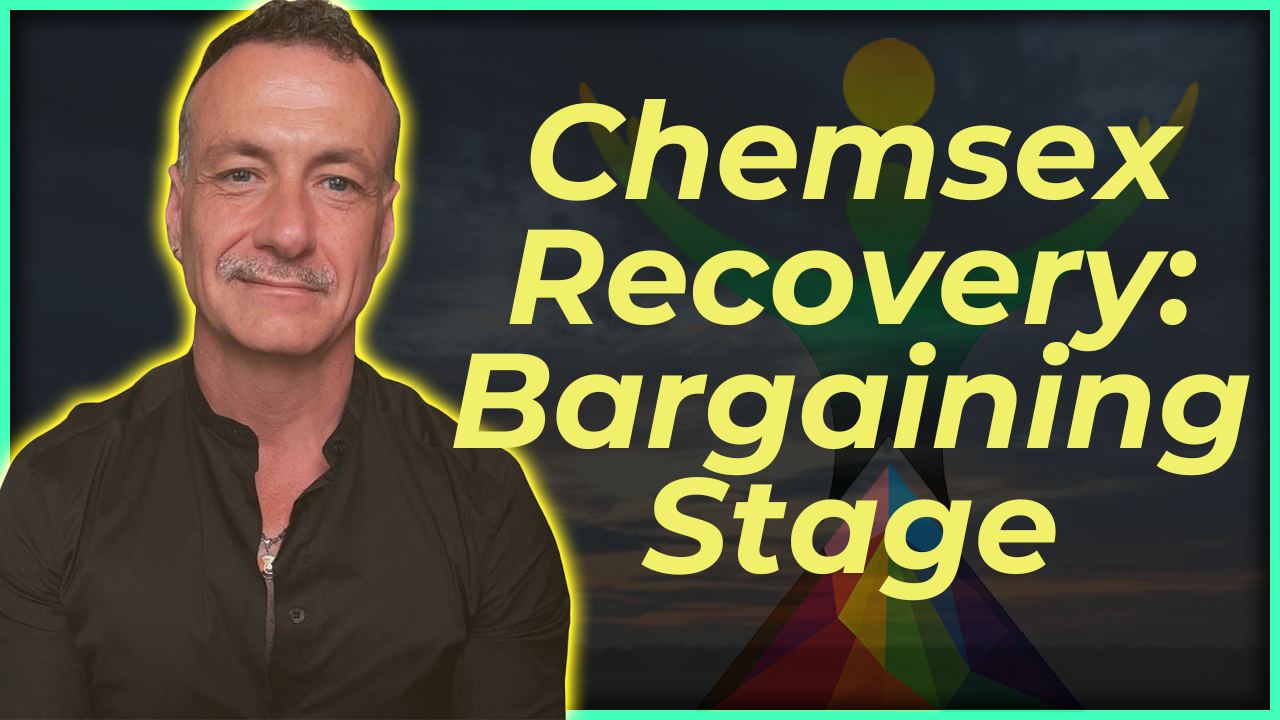
Alright, I hope you are enjoying this series on the 5 Stages of Grief as they relate to Chemsex Recovery. We have walked through denial and through anger. As you begin to move through these stages, you'll feel a shift. The filter has loosened. The rage has quieted. You are seeing more clearly than you were, especially while deep in the denial stage.
And now your mind, the same mind that built the denial in the first place, is going to make you one last offer. It's like a game show; you can have a chemsex-free life or what's behind door #1!!
What's behind that door is called bargaining.
This is the most dangerous stage in the grief of chemsex recovery. Not because it feels the worst. It actually feels the most reasonable. That is what makes it dangerous.
Bargaining is where most relapses live. Bargaining can get us stuck in a loop of trying to find solutions other than the ones in front of us. Bargaining, to me, is a measure of how well you lie to yourself.
The conversation in your head during this stage can be a great reflection of what has kept you in chemsex misuse. This is the perfect time to observe and take notes.
So let's take a deep dive into bargaining:
WHAT BARGAINING ACTUALLY IS
Bargaining is the part of grief where your mind, finally accepting that something has to change, tries to negotiate the terms.
This is the ingrained pattern fighting for its life.
You have moved through enough denial to admit there is a problem. You have moved through enough anger to feel the cost. But you are not yet ready to let it all go. So your mind, in a final act of self-preservation, offers you a deal.
Maybe you can keep some of it.
Maybe not everything has to change.
Maybe there is a version of you who can have one foot in the scene and one foot in your new life.
Maybe the rules of consequence and chemistry do not apply to you the way they apply to other guys.
Maybe you can be the exception.
That is bargaining.
It is the search for a loophole. It is the attempt to keep some piece of the chemsex identity while cherry-picking parts of your new identity.
It is your mind, terrified of full surrender, trying to broker a peace treaty between the old life and the new one.
There cannot be a peace treaty.
That is the part you have not learned yet. The old life and the new life cannot coexist. They are mutually exclusive operating systems. You cannot run both at the same time.
But your mind does not believe that yet.
So it spends this stage running every possible scenario, looking for the exception. And during that search, you are exquisitely vulnerable to relapse.
HOW BARGAINING SHOWED UP FOR ME
I was in the bargaining from day one, to be honest. I called my sister after my first use and told her I had used meth. I distinctly recall minimizing her concern and assuring her that I could do this once in a while.
I bargained with Tina for the full 3 1/2 years.
After my first attempts at stopping, after I had moved through denial about the severity of my use, after I had raged at everyone and everything, I came up against this voice that would not be quiet.
The voice that said, you are different. You can handle this. Other guys cannot, but you can. You have learned enough now. You have grown enough. You can use this the way it was meant to be used.
I tried every variation.
I tried using only once a month.
I tried using only on vacation.
I tried using only with one specific person.
I tried using only on certain holidays.
I tried using only with certain rules. No injection. No more than a certain amount. No more than a certain number of hours.
I tried using only after I had been sober for a certain number of weeks, as if accumulated sobriety somehow earned me a free pass.
None of it worked.
Every single one of those bargains ended the same way. Either immediately, in a session that blew through every rule I had set, or slowly, in a creeping escalation that within weeks or months had me back where I started, and usually worse.
Tina always wins the negotiation.
Every single time.
The bargain looks reasonable on paper, but it cannot survive contact with the substance itself. The moment the substance enters the body, the rules dissolve.
The mind that made the bargain is no longer in the room. A different mind is. And that mind has only one rule, which is MORE.
I do not say this to shame myself or to scare you. I say this because I want you to understand that the bargaining stage is not a phase you pass through quickly if you are not paying attention.
It is a phase that will quietly extend itself for as long as you let it. It will let you call it recovery. It will let you tell yourself you are doing the work. And underneath, it will keep negotiating.
THE VOICES OF BARGAINING
Like denial, bargaining speaks in a vocabulary that sounds reasonable. Listen for these.
It sounds like: If I just stay friends with these guys but do not use, I can keep the community. The community is what I really wanted. The chemical was incidental.
It sounds like: If I just see my dealer one more time, to say goodbye, to give him closure, to end things cleanly, I can keep my word and be done with it.
It sounds like: If I just go to one party sober, to prove to myself that I have control, I will know I am free. Then I will not need to do it again. The proof is the point.
It sounds like: If I can use just on weekends, just on special occasions, just when I am traveling, just when I am with a certain person, just under certain conditions, then I can keep the parts I loved without paying the price.
It sounds like: If I can be one of those guys who has it under control, who can take it or leave it, who uses recreationally without becoming the man I was, then I do not have to give up what felt the most alive about my life.
It sounds like: If I just take a break for a year and then come back, my body will have reset. I will be able to handle it then.
It sounds like: Other guys cannot do it, but I am different. I have done the work. I have grown. I have insight now that I did not have before. The insight will protect me.
Every one of those sentences is a trap. Every one of those sentences sounds like wisdom and is actually denial.
This is the part of bargaining most men miss. They think bargaining is obvious, that it sounds desperate or pathetic. It does not.
Bargaining sounds mature. It sounds measured. It sounds like a man who has done the work and earned the right to a more nuanced relationship with the substance.
There is no nuanced relationship available. That is the lie at the heart of every bargain.
THE LOOPHOLE INDUSTRY
Underneath all the specific bargains is a single underlying belief. The belief that you, specifically, can find the loophole.
This belief is one of the most stubborn structures in the addicted mind. It outlasts denial. It outlasts anger. It will outlast bargaining, too, unless you confront it directly.
The belief says, I am different.
The rules apply to other men, but I have an exception in my case. I have studied this. I have suffered enough. I have done the inner work. I have changed. The man who used cannot use again, but I am no longer that man. I am someone new. The new man can have a different relationship with the substance.
This is the most seductive lie addiction tells. And the longer you stay chemsex-free without dealing with it directly, the more convincing it gets.
Because here is the cruel paradox. The longer you are chemsex-free, the more your body recovers, the more your life rebuilds, the more confidence you accumulate, the more your mind begins to believe that you have somehow earned the right to use again safely.
You have not.
Sobriety does not earn you a future relationship with the substance. Sobriety earns you a future. Period. Those are not the same thing.
Every man who has tried to test the loophole has discovered that the loophole was never real. It was a story his mind was telling him because his mind could not bear the finality of complete release. The mind would rather imagine a flexible future than accept a closed door.
But the door has to close.
That is the whole work of this stage. Closing the door on the negotiation. Letting your mind grieve the loophole it cannot have.
BARGAINING DISGUISED AS RECOVERY
There is a specific form of bargaining that is the most dangerous of all, because it disguises itself as healthy recovery behavior.
It looks like this. You stay sober. You do not use. You go to your meetings or your sessions or your coaching. You journal. You exercise. You look from the outside like a man doing all the right things.
But underneath, you are still in the scene.
You are still texting the guys.
You are still on the apps.
You are still going to the same bars where you used to meet for sessions.
You are still hanging out with the dealer, even if you say it is just to catch up.
You are still in conversation, in proximity, in orbit.
You have not actually left.
You tell yourself you are practicing. You tell yourself you are learning to be in those spaces without using. You tell yourself you are demonstrating your strength. You tell yourself the people in your life still need you. You tell yourself it would be cruel to cut them off completely.
What you are actually doing is bargaining.
You are trying to keep the world of chemsex intact, minus the chemical. You are trying to be the man who belonged to that scene without the cost of belonging. You are paying the social dues without taking the substance.
It will not hold.
The scene is the chemical. The chemical is the scene. They are not separable.
The men in your phone are not separable from what you did with the men in your phone.
The places are not separable from what happened in those places.
The rituals are not separable from the substance that created the rituals.
If you are chemsex-free but still inside the ecosystem, you are not in recovery. You are in the antechamber of relapse. You are bargaining.
You are either chemsex-free or chemsex-free with caveats.
The hardest part of this stage is letting go of the community. Letting go of the guys. Letting go of the places, the apps, the rhythms, the rituals.
Because the chemical was easy compared to the world that came with it. The chemical was the surface. The community was the depth. And grief, real grief, is going to ask you to release the depth, not just the surface.
THE RELAPSE TRAPDOOR
Almost every relapse I have witnessed in my work as a coach lives in the bargaining stage.
The relapse does not come from a man who is still in denial. He is too numb to make a clear decision. The relapse does not come from a man who is still in anger. He is too volatile, but he is also too aware of what he is angry at.
The relapse comes from the man who has accepted the problem, processed the rage, and is now quietly running scenarios in his mind.
The man who is telling himself he has earned the right to test a theory. The man who is engineering a situation where the use will look accidental, situational, justifiable.
He meets up with an old friend. He tells himself it is just to catch up. He goes to a place. He stays a little too long. The friend offers. He hesitates. He uses. And then he tells himself that this was not really a relapse, this was just a one-time thing, he is still in recovery, this does not change anything.
But it changes everything.
Because once the door has been reopened, even slightly, the bargaining has confirmed its own thesis. The mind says, see, you can do this, it was not so bad, look, we are okay.
And the next session is closer.
And the session after that is closer still.
And within weeks or months, the architecture you spent so long building is on the floor.
This is why bargaining has to be confronted directly. Not waited out. Not assumed to resolve itself. Confronted.
You have to make a conscious decision, in writing, with witnesses, that no exceptions exist. That the door is closed. That you are not auditioning for a flexible future with the substance. That you have heard your mind's offer and you are declining it.
Until you do that, you are not in stage four. You are still in stage three. And stage three is where men disappear.
CLOSING
Bargaining is the longest stage for most men. It can stretch out for months or years if it is not confronted directly.
It can hide inside what looks like successful recovery. It can survive intact even while you appear to be doing all the right things.
Based on your ability to compartmentalize or even disassociate from your authentic self, this voice can whisper in the background for a long time.
The way out of bargaining is not to argue with your mind. Your mind will win that argument. Your mind has been running negotiations longer than you have been conscious of them. You cannot out-think the part of you that built the bargains in the first place.
The way out is to declare. Not in your head. Out loud. To another person. In writing. With finality. Inside your heart.
There is no loophole. There is no exception. There is no version of this where I get to keep any of it. The door is closed.
When you say that and mean it, something in you breaks. That breaking is the doorway into depression. Which is where we are going next.
Depression is the hardest stage to write about, because it is the stage where the temptation to use is the strongest and the fewest tools seem to be working. But depression is also where the actual surrender happens.
And surrender, real surrender, is the threshold to the new life.
For now, look at the bargains. Name them. Close the door. Let it hurt.
You are doing the work. The work is brutal. The work is also the only thing that will set you free.
Love you, Dallas
JOURNAL PROMPTS
What deals am I currently trying to make with myself, with my using, with my community, with my future? Name the specific bargains.
What am I most afraid I will lose if I let go fully, with no exceptions, no loopholes, no preserved corners of the old life?
What is the loophole I keep returning to in my mind? The fantasy scenario where I get to have it both ways? Describe it in detail.
Who is still in my life from the scene? Be honest. Not just the guys I am sleeping with, but the guys I am texting, following, staying in proximity to. What am I keeping by keeping them?
If my mind made me one final offer right now, what would the offer be? Write it out as if it were being negotiated.
What would it mean to close the door completely? What would I have to release? What would become possible?
EXERCISE: THE BARGAIN INVENTORY
This exercise is going to ask for honesty most men struggle to give themselves. It is worth it. Do it slowly.
Take out a notebook. At the top, write the words, Every Bargain I Have Made With Myself In The Last Six Months.
Then start listing.
Every time you said, just this once. Every time you said, I can handle it. Every time you said, if I just do this one thing differently, I can still have the rest. Every time you said, I will start tomorrow. Every time you said, I am the exception. Every time you said, I have done enough work to deserve this. Every time you said, this does not count.
Every text message you sent that you knew was opening a door. Every account you said you would delete and did not. Every contact you said you would block and did not. Every visit you said was the last one. Every party you said you would skip and did not. Every drink, every situation, every space you put yourself in while telling yourself you were just testing your strength.
Write all of it. Take a full hour. Be unsparing.
Next to each bargain, write what actually happened. Or, if you have not yet broken the bargain, write what would happen if you followed through on it.
Notice the pattern. Notice how the bargains repeat with slight variations. Notice how each one sounded reasonable in the moment and looks transparent in retrospect.
Then, on a fresh page, write one sentence.
There is no version of this where I get to keep any of it.
Read that sentence out loud. Sit with it. Let it land in your body. That sentence is what closes the door. That sentence is what moves you out of bargaining and into the next stage, which is going to feel worse before it feels better.
But the next stage is where the actual healing begins. The bargain has to die before the man you are becoming can be born.




Responses