Content Warning: This episode and study guide discuss childhood sexual abuse, neglect, abandonment, religious trauma, body dysmorphia, and the unwanted touching of a minor. Please move through this material at your own pace. If you need to pause, pause. If you need support, reach out to a trusted person, a therapist, or a crisis line.
A Note From Dallas
I cried more than once during this conversation, and I'll probably cry again writing this. There's something about sitting across from someone who can name — clinically, gently, without flinching — the exact wound you've been trying to outrun your whole life.
When Kit talked about babies left alone in cribs because the caregivers didn't know what to do, I thought about my dad bragging that they'd shove my crib out into the apartment hallway because I wouldn't stop crying. Teenagers with a baby. I get it now. But that baby — me — learned something in those hallways that took 40-plus years and a meth pipe to finally surface.
This is the work, my friends. Not just putting the substance down. Not just getting to 90 days or six months or a year of being chemsex-free. The real work is going back for that baby, that toddler, that scared kid, and asking: what happened to you? Not, what's wrong with you. The question Oprah finally got the world to ask.
If your ACE score is high — and if you're listening to this podcast, there's a real chance it is — I want you to know two things. One: it is not your fault. Two: it is your responsibility now. Not in a shaming way. In a sacred way. Your healing belongs to you.
Let's get into it.
Guest Bio
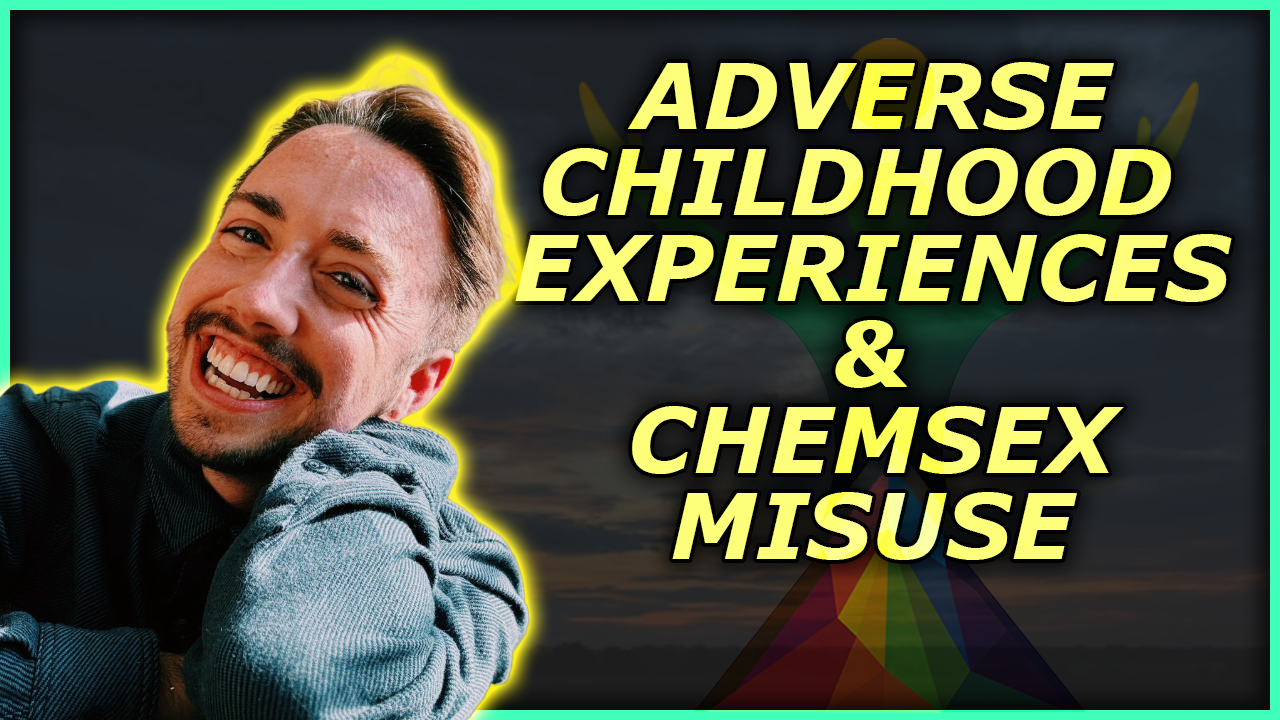
Kit Morgan is a licensed clinical social worker in New York, Virginia, and Indiana, and the creator of The Liberated Porch — a leading platform for queer, religious-trauma-informed care. Kit consults with thought leaders and healers across the globe and has been featured in Out Magazine and as a guest speaker at Colgate University.
Kit's work began in 2014, advocating for formerly incarcerated individuals through interpersonal skills development, training, and research about alternatives to incarceration for non-white men. It came to Kit's awareness that many of the incarcerated individuals had backgrounds in authoritarian Christian groups and felt deep shame about their identities and expressing vulnerability — stories Kit related to personally.
Kit began his career with one foot in and one foot out of the closet before fully emerging into his identities as a queer and trans man who grew up in the Independent Fundamentalist Baptist and Southern Baptist churches, where being out of the closet was unwelcome, dangerous, and labeled sinful. In finding liberation in his identities, Kit pivoted his career to focus on people who have ever felt unsafe in their homes or places of worship because of their gender identity, gender expression, or sexual orientation. While Kit specializes in religious-trauma-informed therapy for queer people, his work also extends to other adult trauma survivors.
You can find Kit on Instagram, TikTok, and Substack under The Liberated Porch, and listen to his podcast of the same name.
What ACEs Actually Are — and Why They Matter for Chemsex Recovery
The Adverse Childhood Experiences questionnaire came out of obesity research. The scientists kept noticing the same pattern: the higher someone scored on a list of childhood adversities, the more likely they were to develop substance use disorders or chronic illness later in life. That correlation has held up in study after study.
Here's what's important for our community: a high ACE score is not a life sentence. It's information. It tells you why your nervous system is wired the way it is, why your cortisol runs hot, why you've been chasing soothing in pipes and parties for years. It tells your doctors and your care team to watch for things sooner. And it gives you a starting place for the deeper work.
I took the ACE assessment back when Oprah was pushing it, and I scored a 10. All ten. By the numbers, I was statistically destined to land where I landed — addicted, almost incarcerated, almost dead. That score didn't depress me. It freed me. Because suddenly there was a name for what I'd been carrying.
If you've never taken it, just Google "ACE assessment." It's free, and you can do it in five minutes. But take it gently. The point is not to add up your wounds and despair. The point is to finally see them.
Shame Did Not Get You In — and Shame Will Not Get You Out
Kit said something I want every chemsex recovery space in the world to hear: addiction as a moral failing is an archaic idea, and it breaks his heart that addiction practitioners and peer recovery groups still push it.
If you're in a recovery circle — any recovery circle — and the message you're getting is that you're broken, you're weak, you just need to try harder, you should be ashamed of yourself, get out. I mean it. Get out today. That circle is sending you right back to the dealer. Shame is the gasoline of this disease, not the cure.
The real failing was never yours. The failing was a vulnerable child who needed soothing and didn't get it. The failing was a system that couldn't hold the family that couldn't hold you. And we can have compassion for the caregivers who couldn't meet your needs, too — because most of the time they were caught in the same chain reaction. That doesn't excuse what happened. It just refuses to keep punishing the wrong person — you.
The reframe Kit offers is this: stop asking what's wrong with me that I can't quit? Start asking what hurt has been driving me to need this? The first question keeps you locked in symptoms. The second one opens the door.
Resentment, Forgiveness, and the Two Truths You Can Hold at Once
This one is huge, and it's something I've been getting wrong for years.
Holding onto resentment toward people who hurt you can absolutely keep you in relapse. That part is true. But — and this is what most recovery rooms get sideways — research is now showing that forgiving an abuser may actually raise your risk of returning to that abuser. Forgiveness is not the medicine we've been told it is. Not always. Not for everyone.
Kit names it as holding two truths at once: you can release the resentment without forcing yourself to forgive. You can grieve what happened, name it as not okay, move through the anger that's part of grief, and arrive somewhere like acceptance — without ever having to hand the person who harmed you a clean slate. That slate is not yours to give them. Your job is your own healing.
The piece that sustains long-term recovery, Kit says, is meaning-making. Once you've grieved, once you've reached some kind of acceptance, the next move is to ask: what am I going to make of this? What does my pain become in service of? For some of us, that becomes a podcast or a coaching practice or a sponsor seat in someone else's recovery. For others, it's quieter — it's becoming the kind of friend you needed when you were 19. Meaning-making is not optional in this work. It's how the wound becomes the well.
The 60 Days of Gentleness Protocol
This was, for me, the most clinically useful thing Kit shared. I want you to read this section twice.
For people with ACE histories who didn't get appropriate soothing as kids, Kit prescribes 60 days of gentleness. He's noticed that a lot of his clients with addiction histories — and I'll say especially in our community — are running on high-impact activities to regulate themselves. Hard kink and BDSM dynamics where they're either denying themselves pleasure or absorbing pain. Punishing gym workouts that leave them wrecked the next day. Mental overdrive at work. Constant family obligations that drain every ounce of fortitude. We're soothing the under-soothed baby with more force.
The 60-day protocol asks you to step out of those high-impact spaces and step into deliberate gentleness. That can look like:
- Swapping the heavy lifting for yoga or lower-intensity strength training
- Pausing kink dynamics that involve pain or pleasure denial, and instead engaging in pleasure-giving and pleasure-receiving with people who feel safe
- Increasing your sleep instead of shortening it
- Slowing down your food — Kit specifically named crock-pot meals — instead of grabbing fast food on the run
- Stepping back from family interactions that demand high mental fortitude, if you safely can
- Getting into nature in a relaxed way, not a performative way
And — this is critical — gentleness is not isolation. Self-isolating is not gentle, it's punishing. Gentle activities done with safe people are part of the medicine.
What Kit sees in his clients after 60 days: hypervigilance drops. Impulsivity drops. Self-esteem rises. The nervous system, finally, gets the message that the war is over.
If journaling isn't your thing — and Kit named that journaling can actually increase rumination for some people, and isn't accessible for everyone — try the empty chair exercise instead. Sit across from an empty chair and speak to it as your younger self, your future self, or someone from your past or present. Then switch chairs and answer back as them. It's cathartic in a way that words on a page sometimes can't reach.
After the 60 days, Kit calls what comes next a recalibration. Looking at relationships, work, family — and asking what needs to change now that your system has finally been still enough to hear itself.
Skin Hunger, Pleasure Deprivation, and Why Meth Felt Like the Answer
I'm going to be vulnerable here because Kit invited me to be, and because I think a lot of you need to hear this.
I told Kit on this episode about a retreat I went to last year with a friend I call my intimacy friend. We laid down naked together with explicit boundaries — no kissing, no genital touching. Just being held. And it tore me apart. It was the first time in my adult life I felt someone wanted to touch me with no transactional expectation. I broke down. I could not stop crying. And then I got angry that I was almost 50 before I felt that for the first time.
Kit named it perfectly: skin hunger. The earliest form of intimacy is being held and swaddled as a baby. When that's missing, the deprivation starts before you have language for it. And then we grow up into a community that often does the opposite of slow, safe, clothed-on holding. We do quick. We do transactional. We do drugged. And underneath it all, that under-held baby is still reaching.
Meth, for a lot of us, was the first thing that ever felt like the pleasure and intimacy we'd been denied for decades. That's not a moral failing. That's a body finally getting fed something it had been starving for. Of course it grabbed on with both hands.
I also shared on the episode about dating a trans man last summer and getting it badly wrong — misgendering him, asking ignorant questions, leaning on him to educate me when that was never his job. He blocked me, rightfully. That experience sent me back to school. I'm in a sexology course now learning what I should have known going in. I bring it up here because part of recovery is learning to take accountability without collapsing into shame about it. Kit named that too: in our community, taking responsibility when we're learning new things is part of the work.
And one more piece, because it ties everything together: the I'm a giver identity. So many of us in this community wear that like a badge. Kit pushed back on it gently. Sometimes "I'm a giver" is real generosity. But sometimes it's I don't know how to ask for what I want. Sometimes it's receiving feels unsafe. Sometimes it's I don't even know what I'd want if I could have it. If any of that lands, sit with it. That's an ACE conversation in disguise.
A Closing Word From Dallas
If you took anything from this episode, let it be this: you were not born broken. You were born into something that broke. And the meth, the chems, the parties, the pipes — those were the best tools your body could find to keep you alive in a world that wasn't holding you the way you needed to be held.
Becoming chemsex-free is the door. The ACE work is the house. Don't stop at the door.
Take the assessment. Find a trauma-informed therapist — and please, find one who understands queer lives, like Kit. Try the 60 days of gentleness, even imperfectly. Let yourself be held without a transaction attached. Cry when you need to. Make meaning out of every single thing you've survived.
You can do this work. And you don't have to do it alone.
Love you, Dallas 💚
Reflective Questions
- When you imagine yourself as a baby or small child crying without comfort, what feeling rises in your body — and where in your body do you feel it?
- Where in your current life are you still trying to soothe an under-soothed child with high-impact intensity (work, kink, gym, parties, productivity, caretaking)?
- Whose forgiveness have you been pressuring yourself to give — and what would it free up if you released the resentment without granting the forgiveness?
- What does the phrase "I'm a giver" mean for you, honestly? Generosity, avoidance of asking, fear of receiving, or something else?
- If your chemsex use was your body's attempt to feed a starvation that started long before the drugs, what was it actually trying to feed?
Journal Prompts
- Take the ACE assessment today. Write down your score, then write a letter to the child you were at the age each "yes" started. Tell them what they needed to hear back then.
- Describe one moment from your childhood when you needed soothing and didn't get it. What did you decide about yourself in that moment? Is that decision still running your life?
- Write about a time someone touched you, held you, or paid attention to you with no transaction attached. If you can't think of one, write about what you imagine that would feel like.
- List the high-impact activities currently in your life. Beside each one, write what it's giving you and what it might be costing you.
- Write your meaning-making statement. Finish the sentence: "Because of what I survived and what I'm healing, I am here to ______."
Action Exercises
- Take the ACE assessment. Google "ACE assessment," complete it this week, and bring your score to your therapist, coach, sponsor, or trusted friend for a real conversation about what it means.
- Start the 60 Days of Gentleness. Pick a start date in the next seven days. Identify one high-impact activity to pause and one gentle activity to add. Mark it on your calendar and tell one safe person.
- Try the empty chair exercise once this week. Set out an empty chair. Speak aloud to your younger self about something they needed and didn't get. Then switch chairs and let that younger self respond. Stay with it for at least ten minutes.
- Schedule one non-transactional touch experience this month. A massage from a licensed therapist, a cuddle session with a safe friend, a hug held three seconds longer than usual with someone you trust. Notice what comes up. Don't run from it.
- Find a trauma-informed, queer-affirming therapist or coach. If you don't have one yet, this is the week. Start with Psychology Today's directory, ask in your recovery community, or reach out through drdallasbragg.com if you'd like to explore working with me or Bobby in Recovery Alchemy.

Responses