
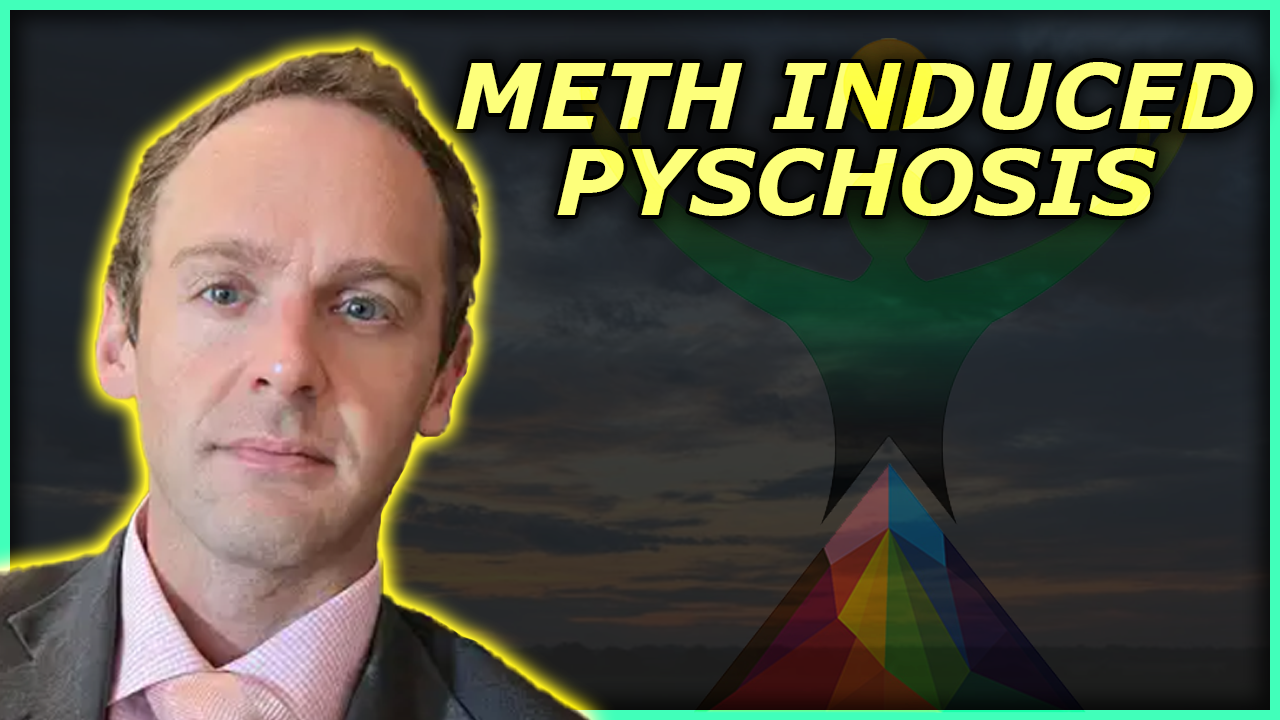
Content Warning: This episode discusses meth-induced psychosis, paranoia, hallucinations, traumatic experiences during use, and a near-death encounter. Please listen and read with care, and pause when you need to.
A Note From Dallas
I want to take you somewhere I don't talk about often.
There was a stretch of my using where nine days awake was just… my average. I'd go and go until I crashed. But one night, something clicked differently. I had just been arrested for the first time, I was on probation, and instead of passing out, I curled up in the corner of my bedroom convinced the house was surrounded. I forgot how to use my phone. My instinct — my muscle memory from being high — was to open Grindr. So that's what I did. I started messaging strangers for help. You can imagine how that went.
The shadows in the windows looked real. The footsteps outside felt real. All of it felt real.
That was one of the only times I personally experienced full-blown psychosis. But I cannot tell you how many men I've used alongside who lived in it — and how many stayed in it long after the drugs left their system. I have always had the softest spot in my heart for those guys. The ones who can't tell anyone what they're seeing because they're terrified of being called crazy. The ones who think they're broken beyond repair.
This episode is for them. And it might be for you.
I brought on Dr. Patrick Lockwood — a licensed clinical psychologist out of LA who has spent his entire career in what he affectionately calls "Rehabistan" — to help us understand what's actually happening in our brains, what we can do about it, and most importantly, why none of this means we are damaged goods.
If this is your story, please read this guide slowly. Take notes. Come back to it. You are not crazy. You are not alone. And you are not beyond help.
About Our Guest
Dr. Patrick Lockwood is a licensed clinical psychologist based in Los Angeles. He has spent the bulk of his career working with severe substance use disorders across every level of care — from luxury treatment programs to community mental health to psychiatric hospitals. He is also a professor at California Lutheran University, where he trains future doctors and provides clinical supervision. Patrick brings both professional expertise and a deeply personal investment in the chemsex community, and he speaks about psychosis with a rare combination of clinical precision and human warmth.
Paranoia Lives On a Spectrum — And That Matters
One of the most freeing things Patrick said in this conversation is that paranoia isn't a switch. It's a dial. On one end, garden-variety suspicion is actually healthy — being a little wary of the driver next to you who's looking at their phone is adaptive. On the other end, paranoia is constant, distressing, and impairing your ability to live.
Most of us in chemsex recovery have been somewhere on that dial. Maybe you weren't ripping vents off the wall looking for cameras, but maybe you couldn't shake the feeling your neighbor knew. Maybe you thought your phone was tapped. Maybe you read hostility into a friend's text that wasn't there.
This matters because so many of us pathologize ourselves as "psychotic" or "ruined" when what we're actually experiencing falls on a spectrum that we can learn to manage. Naming where you are on that dial — without judgment — is the first move.
Delusions Are Reflexes, Not Character Flaws
The metaphor that stopped me in my tracks: a delusion is like a sneeze.
You don't choose to sneeze. Your nose gets irritated and your body sneezes — that's a reflex. Patrick is saying paranoid thoughts are the same kind of reflex. Your brain is misreading the environment and doing what it thinks it needs to do to keep you safe. The thought itself is not a moral failing. It's not proof you're broken. It's a reflex from a brain that's been chemically and emotionally overwhelmed.
This reframe matters more than I can say. So many of us layer shame on top of our symptoms — "I shouldn't be thinking this, what's wrong with me, I'm crazy" — and that shame is its own injury. If you can start to see the intrusive thought the way you'd see a sneeze — annoying, uncomfortable, but not a reflection of who you are — you free yourself to actually work with it instead of fighting yourself.
You Manage It. You Don't Solve It.
This was the hardest truth in the episode, and also the most useful one.
Patrick was clear: paranoia doesn't disappear because you proved to yourself there's no camera in the vent. You can rip the vent apart and the belief stays. Even the best medications often don't make delusions vanish. So what works?
Distraction in small doses. Not avoidance — intentional interruption. Pulling your attention off the fixation long enough to give your brain a breath.
Reality testing. When you have enough capacity, asking yourself: What do I actually believe here? On what basis? What evidence would change my mind?
Catching catastrophic thinking. When the paranoia hits and you immediately spiral into "I'm crazy, I'm broken, this is the rest of my life" — that catastrophizing makes everything worse. Naming it as catastrophizing is the first step in not getting swallowed by it.
The expectation shift is everything. If you go in trying to solve paranoia, you'll set yourself up for failure. If you go in trying to manage it — like managing a sneeze with your elbow up — you give yourself a chance to live alongside it without being controlled by it.
The Brain Heals — On Its Own Timeline
I asked Patrick the question I get asked most: Will my brain heal?
His answer was honest and kind. Most people he's worked with have had substantial symptom relief over time. But the timeline is individual. It depends on how long you used, what else you used, what other patterns hurt your brain, and what resources you have now to support healing.
What he kept coming back to was patience. Not the passive kind — the active kind. Are you doing the reasonable things in your power right now? Sleep. Water. Food. Exercise where you can. Medication if it's indicated. Connection. The simple things, done consistently, are how the brain rebuilds.
You probably want to feel better fast because you're scared and tired of seeing yourself as broken. I get it. But the rush itself is part of what keeps us stuck. Slow, reasonable, patient — that's the road.
You're Not Broken
We ended the conversation here, and it's where I want to leave you too.
So many of the men I've watched go through this carry a private belief that they have permanently destroyed themselves. That what they're experiencing is proof there's no coming back. Patrick was unequivocal: that belief is wrong. There's a difference between men who know they're having a paranoid episode and the ones who are trapped inside it without knowing — and either way, neither group is broken. They are hurting. They are struggling. They are responding reflexively to something their brain went through.
If you're in it right now, find people. A therapist if you can. A CMA meeting if therapy isn't accessible. One trusted friend if neither is. We are mammals. We are not built to suffer alone, and the isolation we live in is half the wound. Walk through this with someone — anyone — who has your back.
You are not crazy. You are not damaged goods. You are a person whose nervous system has been through something extraordinary, and it is asking you to be patient with it while it finds its way home.
Closing
If today's conversation hit something tender in you, please don't sit with it alone. Reach out — to a clinician, a meeting, a friend, or to me. I read every message that comes through drdallasbragg.com, and the Recovery Alchemy community is built for exactly this kind of work.
Whether you're nine days chemsex-free or nine years in, what you're carrying matters. And it can get lighter.
Love you,
Dallas 💚
Reflective Questions
- Where do you currently sit on the paranoia/suspicion spectrum Patrick described — and how has that location shifted since you stopped (or started cutting back on) using?
- When you experience an intrusive or paranoid thought, what story do you immediately tell yourself about what it means about you as a person?
- What does the "sneeze" metaphor change — if anything — about how you relate to your own intrusive thoughts?
- Where in your life are you trying to solve something you might actually need to manage?
- Who in your life has shown you that you are not broken — and have you let yourself believe them?
Journal Prompts
- Write about a specific moment during your use when paranoia or hallucination took over. What did you see, hear, or believe? What do you want your sober self to say to the version of you in that moment?
- Make a list of the catastrophic thoughts that show up most often for you — the "I'm crazy, I'll never recover, I've ruined myself" loops. Next to each one, write a more reasonable response in your own voice.
- Describe the experience of carrying something you've been afraid to name out loud because you thought it meant you were broken. What would it feel like to set that label down?
- Write a letter to your brain. Thank it for what it did to keep you alive during use, and tell it what you're willing to do now to help it heal.
- Reflect on patience. Where in your recovery are you rushing yourself? What would it look like to give your healing a more honest timeline?
Action Exercises
- Map your dial. Spend a week tracking moments of suspicion or paranoid thinking in a notes app. Rate each one 1–10. Watch the pattern. The act of noticing without judgment builds the metacognition Patrick described.
- Practice intentional interruption. Identify one go-to distraction technique you can use when fixation hits — a walk, cold water on your face, calling someone, a specific song. Use it deliberately at least once this week and note what happens.
- Run a reality test. Pick one belief that's been gnawing at you and walk it through three questions on paper: What do I believe? On what basis? What evidence would change my mind? Sit with whatever comes up.
- Do one brain-healing basic, every day, for seven days. Pick one — water, sleep before midnight, a 20-minute walk, one real meal — and do it without negotiating. Don't add more until that one is steady.
- Reach out to one person this week. A therapist, a sponsor, a CMA meeting, a friend, a coach. The point isn't to fix anything. The point is to stop carrying this alone for the length of one conversation.

Responses