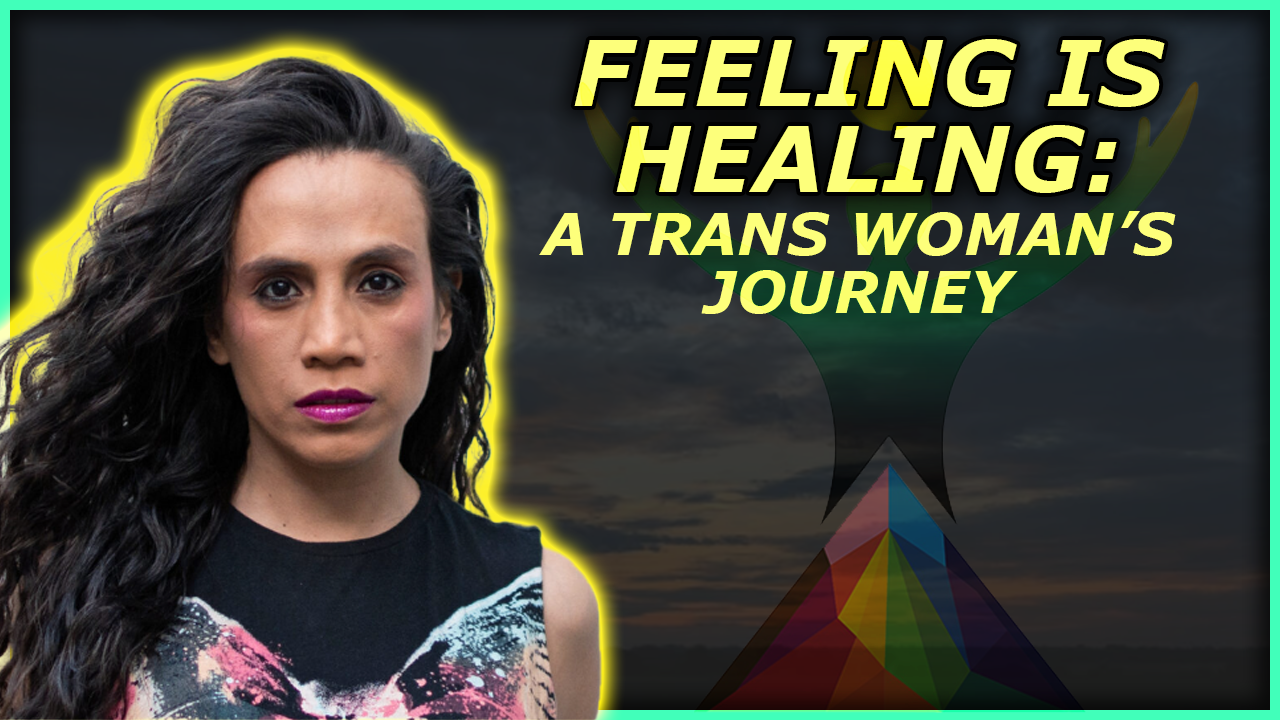
A Conversation with Amanita Calderon-Cifuentes
Dear Friend,
I want to be honest with you before you read a single word of this guide: this episode challenged me. Not because I disagreed with my guest — but because she said things out loud that I've been circling around for years, and she said them with a clarity and a fearlessness that stopped me cold.
Amanita Calderon-Cifuentes is a Colombian trans woman, a PhD in molecular biomedicine, and an HIV research and advocacy officer at TGEU — Trans Europe and Central Asia. She is also a person who uses drugs. She said that plainly, without apology, and without shame. And in doing so, she cracked something open in this conversation that I think a lot of you have needed.
This is not an episode that tells you to stop. It's not an episode that tells you to keep going, either. What it does — and what I hope this guide helps you do — is invite you to get curious. Curious about why you use. Curious about what you're running from, or running toward. Curious about the shame you carry and where it actually came from.
Amanita said something near the end of our conversation that I keep coming back to: What you're most often looking for is connection. Connection to others, but also to yourself.
That landed somewhere deep in me. Because if that's true — and I believe it is — then the work isn't just about putting down the pipe. It's about learning to reach toward yourself with the same love you're desperately searching for in a chem sex session.
That's the invitation of this episode. I hope you accept it.
Love you, Dallas 💚
About Amanita Calderon-Cifuentes
Amanita Calderon-Cifuentes is a Colombian trans woman based in Berlin. She holds a PhD in molecular biomedicine and has spent over a decade working at the intersection of HIV research, advocacy, and trans rights. She serves as HIV Research and Advocacy Officer at TGEU — Trans Europe and Central Asia — where her work focuses on the sexual and reproductive health of transgender people across Europe, Central Asia, and globally.
She has represented TGEU on the Program Coordinating Board of UNAIDS and consults with pharmaceutical companies and European institutions on the biomedical needs of trans communities. Amanita is also a person with lived experience of drug use, chemsex, and the complex terrain of harm reduction — and she brings all of that experience into this conversation without apology and without performance.
The Spectrum of Recovery
One of the most important things Amanita offered in this conversation is a reframe that many of you may find uncomfortable at first — and liberating shortly after. Recovery, she argues, does not have a single shape. Abstinence is one point on a spectrum, not the definition of the entire spectrum. On the other end is active, unmanaged use. And in between? A wide, complex landscape that most of the recovery industry refuses to acknowledge.
This matters for our community in particular. So many of the men I work with come to me crushed under the weight of binary thinking: I either stop completely or I'm a failure. And when they relapse — as many do, because that is the nature of addiction — that binary thinking doesn't just disappoint them. It destroys them.
Amanita's framework doesn't excuse harmful use. She is clear that her own meth use was, at points, deeply problematic — meaning it was interrupting her life and harming her wellbeing. But she draws a distinction that I think is critical: the goal she set for herself was never simply to stop. The goal was to understand. To connect with the pain and shame underneath the use, so that the use no longer had to do that work for her.
That is a different kind of recovery. And for some of you, it may be the only kind that will ever actually stick.
Drug, Set, and Setting
Amanita introduced a framework that I want you to sit with: every drug experience is shaped by three factors — the drug itself, your set (your internal state, your psychology, your history), and your setting (your environment, your circumstances, the people around you).
This is not abstract theory. This is your life. When you use meth, you are not just using a chemical. You are bringing everything you are into that experience — your shame, your loneliness, your longing for touch, your internalized homophobia, your history of trauma, your hunger for intimacy that the straight world has told you is wrong or dirty or too much. The drug floods your brain with dopamine and shuts down the prefrontal cortex — the part of you that enforces the rules, that carries the shame, that tells you what you're allowed to want. And for a while, you feel free.
But the freedom is borrowed. When the drug wears off, the cortex comes back online. And with it comes everything you were temporarily relieved of — the shame, the self-judgment, the disgust. Often worse than before, because now you have the actions of the session to contend with as well.
Amanita's point is not that this means you should never use. Her point is that if you are going to make any real change — whether that means reducing, managing, or stopping — you have to understand your set. You have to know what you're bringing to the drug, because the drug is going to amplify it. Every single time.
The Biochemistry of Why It Hooks You
Amanita did something in this episode that I found genuinely valuable — she explained, in plain language, what methamphetamine actually does to your brain. Not to frighten you. Not to shame you. But because understanding the mechanism gives you something to work with.
Meth is a methamphetamine — a stimulant that floods your central nervous system with dopamine, noradrenaline, and cortisol in quantities that your brain is not designed to sustain. The dopamine creates the pleasure and the drive. The cortisol shuts down inhibition. And because your brain is flooded — not just stimulated — the reuptake is inhibited too, meaning the receptors stay saturated far longer than they would under normal circumstances.
The consequences of extended use — days without sleep, without food, without hydration — are not just physical. Your brain, exhausted and deprived, can no longer accurately process what's happening around you. It begins to fill in the gaps. And what does it fill them with? Whatever lives in the deepest, most unresolved part of you. The shame. The fear. The memories of violence or rejection or abandonment. That is the architecture of meth-induced psychosis — not a malfunction, but your traumatized nervous system doing the only thing it knows how to do.
Knowing this doesn't make it easier to stop. But it does mean that the psychosis, the paranoia, the terror — those aren't signs that you're crazy. They're signs that your body has been pushed past its limit by a substance that is genuinely, biochemically, one of the most demanding things you can ask your brain to survive. You deserve to understand that about yourself.
Shame, Transphobia, and the Walls We Use to Survive
Amanita spoke with extraordinary frankness about the particular burden that trans women — and trans sex workers especially — carry when it comes to drug use. For many of her clients, crystal meth was not just recreational. It was functional. It made bearable what could not otherwise be borne: the experience of servicing men who desired her while simultaneously hating what that desire said about them.
She described something I find heartbreaking and true in equal measure. These men come to her carrying attraction and self-loathing in the same breath. Many of them have never spoken to anyone about what they want. The shame is total. And in the chemical release of a chem sex session, something cracks open — a conversation, a moment of honesty, a flash of genuine intimacy — that they have never been able to access sober.
I want you to hear this if you are a gay or bisexual man who uses meth to access intimacy or sex: you are not broken. You are not pathological. You are a person who was taught that your desire is shameful, your body is wrong, and your pleasure is a problem. Meth gave you a workaround. It lifted the ceiling of what you were allowed to feel. The tragedy is not that you found that relief. The tragedy is that you needed a drug to get there in the first place.
The work — the real work — is building a life where the ceiling doesn't exist. Where you can want what you want, feel what you feel, and reach toward intimacy without first having to chemically dismantle the part of you that was taught to be ashamed.
That is not a short project. But it is the only one worth doing.
Self-Love as Action, Not Affirmation
Amanita offered one of the most grounded definitions of self-love I have ever heard, and I want to make sure you don't miss it. Self-love, she said, is not standing in front of a mirror and telling yourself you're beautiful. It's not affirmations. It's not the language of wellness culture. Self-love is recognizing a need and meeting it. It is sitting with a feeling instead of running from it. It is making choices — small ones, daily ones — that prioritize your actual wellbeing over what is comfortable or familiar or numbing.
She also said something that I think speaks directly to the men I work with: the only unconditional love available to you is the love you give yourself. Other people can love you deeply, but if you harm them enough, long enough, that love has limits. You are the one person you cannot leave. Which means the relationship you have with yourself is the most consequential one in your life — and for most of us in recovery, it is the most neglected.
Amanita described how she began to reduce her problematic meth use. Not by swearing off the drug. Not by shaming herself into stopping. But by addressing the underlying feelings that made the drug necessary. By sitting in the discomfort. By crying — and she noted, beautifully, that crying is biologically functional: the serotonin produced when you cry is designed to increase your tolerance to pain. Your body already knows how to heal. The question is whether you will let it.
Community as Medicine
Amanita grew up Colombian, and she credits her culture with teaching her something that individualistic, capitalist societies actively work to suppress: that we need each other. That interdependence is not weakness. That community care and self-care are not in tension — they are the same thing, expressed in different directions.
She described neighbors sharing rice and milk during blackouts caused by guerrilla attacks. She described the way shared crisis created shared humanity. And she connected that directly to recovery: she would not be alive, she said plainly, if not for the network of people who had her back. People who loved her without judgment, who showed up when she was not okay, and whom she showed up for in return.
For our community — gay and bisexual men, many of whom have been rejected by family, isolated by shame, or cut off from the networks that sustain other people — this is not a small thing. It is everything. Recovery does not happen in isolation. It happens in relationship. In the messy, imperfect, sometimes disappointing work of letting other people see you and choosing to stay anyway.
If you are using in secret, if you are white-knuckling through days alone, if you have convinced yourself that you don't need anyone — I want to gently push back on that. The independence you're performing is a survival strategy. It is not the same as thriving. And it will never be enough to sustain real change.
Closing Reflection
Amanita closed our conversation with words I want to leave with you: What you're most often looking for is connection. Connection to others, but also to yourself.
That is the heart of this episode. That is the heart of why so many of us used in the first place — because we were starving for something that the world had told us we weren't allowed to have. Belonging. Intimacy. Pleasure without punishment. The feeling of being held.
Recovery, in whatever form it takes for you, is the process of learning to reach for those things without the drug as an intermediary. It is slow work. It is painful work. It will ask you to feel things you have spent years avoiding. But the other side of that feeling is not emptiness — it is lightness. Amanita described it that way, and I believe her, because I have lived it too.
You are not a demon to be defeated. You are a person in pain who found a way to survive. The question now is whether you're ready to find a way to live.
Reflective Questions
- Amanita describes drug use as shaped by the drug, your set, and your setting. When you reflect on your own use, what does your set — your internal emotional state — typically look like in the moments before you use?
- She argues that the goal of recovery doesn't have to be abstinence — it can be understanding. Does that reframe feel liberating, threatening, or both? What does your reaction tell you about the beliefs you've internalized about what recovery is supposed to look like?
- Amanita describes meth as something that temporarily lifted her inhibitions and allowed her to access intimacy she couldn't reach sober. What does meth — or chemsex more broadly — give you access to that you struggle to access without it?
- She talks about the experience of men who desire trans women but are consumed by shame about that desire. In your own life, where has shame about your sexuality or your desires driven your behavior — including your use?
- Amanita defines self-love as action: recognizing a need and meeting it, sitting with a feeling instead of running from it. By that definition, what does self-love look like — or need to look like — in your life right now?
Journal Prompts
- Amanita said that the second she started addressing her underlying pain and shame, the less she needed to use. Write about the feelings or experiences you believe are underneath your drug use. What are you medicating? What are you reaching for? What are you trying to quiet?
- She described the Colombian culture of interdependence — neighbors sharing food, community forming in crisis — as something that saved her. Write about your own relationship with community. Who has your back? Who do you let see you when you're not okay? If that list feels short or empty, write about what gets in the way.
- Amanita spoke about sexual shame — her own, and the shame she witnessed in her clients. Write about the shame you carry around your sexuality, your body, or your desires. Where did that shame come from? How old were you when you first felt it?
- She talked about the difference between rationalizing feelings and sitting with them — and said the only way feelings can transform is if you give them space to exist. Write about a feeling you have been rationalizing, explaining away, or avoiding. What would it mean to simply sit with it?
- Amanita said, "You are stuck with yourself for the rest of your life — so it's kind of worth it." Write a letter to yourself as though you are someone who has chosen to be on your own side. What would you say? What would you stop saying?
Action Exercises
- Map your set. Before your next difficult moment — whether that's a craving, a conflict, or a low day — pause and name three things that are true about your internal state right now. Not what happened, but what you feel. Practice this daily for one week and notice what patterns emerge.
- Reach toward one person. Identify one person in your life who you trust even partially, and tell them one true thing about what you're going through. Not the whole story. Just one true thing. Notice what happens in your body when you do.
- Meet one need today. Using Amanita's definition of self-love — recognizing a need and meeting it — identify one genuine need you have right now (rest, food, movement, connection, silence) and take one concrete action to meet it before the day is over.
- Get curious about your use. If you have used recently, or when you use next, try to identify: What was I feeling before I used? What was I hoping the drug would do? What did it actually do? You don't have to change anything yet. Just observe.
- Find your community. Research one space — a support group, an online community, a recovery program, a social group for LGBTQ+ people — that you have not yet tried. You don't have to commit to anything. Just find it. Know it exists. Take that one step toward it.

Responses