Content Warning
This episode and study guide discuss methamphetamine and chemsex, sexualized drug use, sexual content and sexual identity, shame, trauma, mental health crisis, racial exploitation within the gay community, and relapse. The material may be triggering for some readers. Please move through it at your own pace, take breaks as needed, and reach out to a trusted person or professional if anything here brings up more than you can hold alone. Nothing in this guide is medical advice.
A Personal Note from Dallas
I came out at thirty-six.
By the time I did, I had already spent a lifetime being someone else — building a life, a family, a reputation around a version of me that was never quite true. And when I finally stepped into gay life, I stepped in as a full-grown man with no map, no mentors, and one sentence running on a loop in my head:
I have to make up for lost time.
That sentence is the whole reason I wanted to do this episode.
What I found on the other side of coming out wasn't the belonging I'd imagined. I found a population that had its own language, its own rules, its own hierarchies — and I didn't fit any of them. I had arrived late to a party that had been going on for twenty years, and the loneliness of that was sharper than the closet had ever been. So when I found a space where I was wanted — where being older meant being desirable, where I had something people came looking for — I didn't just find a drug. I found a place to belong.
That's what makes this so hard to walk away from. Chemsex-free recovery for a late-bloomer isn't just quitting a substance. It's giving up the first place you ever felt like you'd arrived.
Darrell and I spend this episode naming that out loud, because almost no one is. There's very little scholarship here. There's even less honest conversation. If you came out in your thirties, forties, fifties, or later — and if what followed was faster and harder than you expected — this one is for you.
You didn't waste your life. You were surviving it. And there is time.
Love you, Dallas 💚
About Our Guest
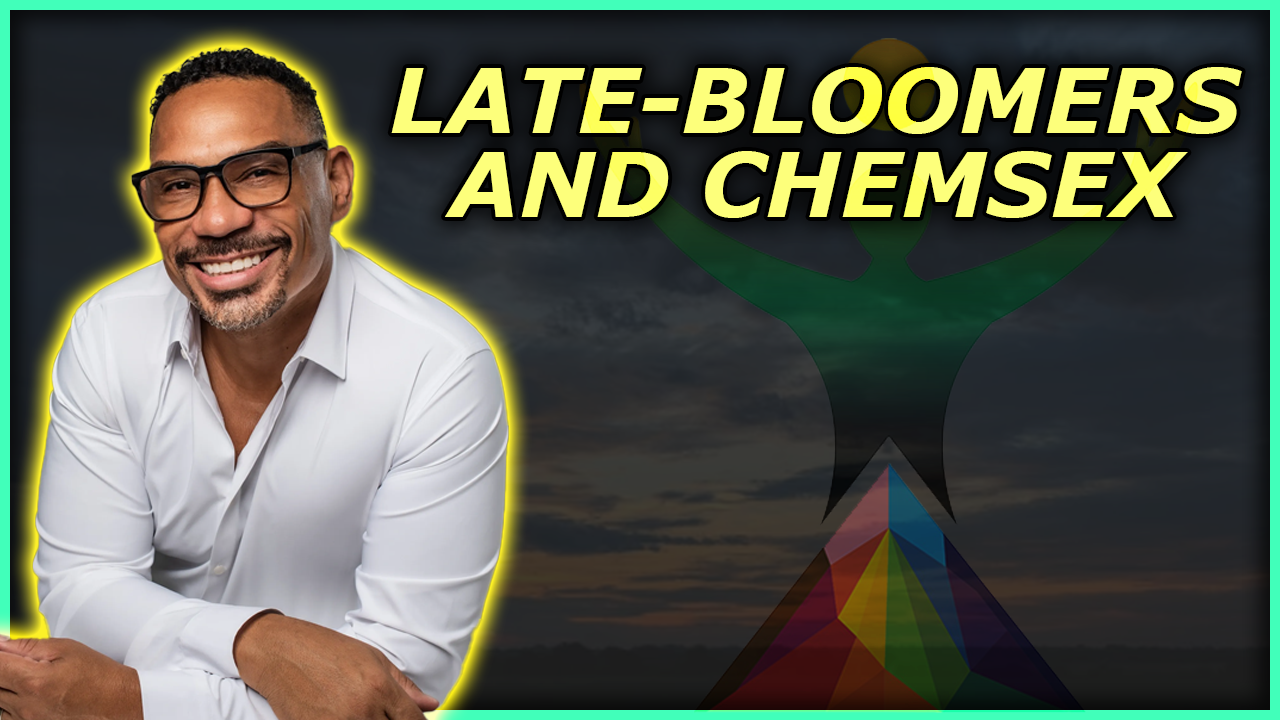
Darrell Martin, LCSW is a transformational psychotherapist and musician based in New York City whose work bridges emotional healing, creativity, and cultural insight. A proud Afro-Hispanic gay man, he brings a deep commitment to serving individuals of all identities, orientations, and backgrounds — particularly those with complex life histories.
With graduate training from New York University and an undergraduate degree in entrepreneurial diversity studies and intersectionality from the City University of New York, Darrell specializes in identity shifts, emotional breakthroughs, and life redesign. In private practice and through Artists Reimagining Therapy and Systems Arts — a program he co-founded with a fellow Broadway artist turned clinical therapist — he provides accessible, systems-focused mental health care to New York City's artist community. His clinical work spans assessments, substance dependency counseling, individual and couples therapy, polycule therapy, organizational psychology training, and group facilitation.
Before his career as a psychotherapist, Darrell spent three decades immersed in the music and arts world. A graduate of a performing arts high school, he became part of New York's legendary ball scene through members of the House of Xtravaganza and appeared in the groundbreaking documentary Paris Is Burning. His artistry extended to performing, writing, and producing for cultural icons. During the COVID-19 pandemic, he launched a national program uniting therapists and artists to confront inequities in mental health care. In 2024, he received Crain's Notable Leaders in Mental Health Care Award.
Darrell is finishing his memoir, Scarred, Fierce, and Unbreakable: My Lessons in Pain, Pride, and Healing in NYC. He lives in New York with his husband, and together they have raised five children.
Section One: "Making Up for Lost Time" — The Late-Bloomer's Engine
There is a specific psychological state that men who come out later in life carry into gay culture, and Darrell names it precisely: a sense of loss, of wasted years, of urgent catching up.
That urgency is not a character flaw. It is grief that hasn't been given anywhere to go. A man who spent twenty, thirty, or forty years performing a life that wasn't his does not simply walk into freedom — he walks in carrying every year he didn't get to live, and the arithmetic of how many are left.
The problem is what that math does to decision-making. When you believe you're running on borrowed time, delay feels like loss. Patience feels like more theft. And every offer that promises right now becomes disproportionately powerful, because right now is the only currency that answers the panic.
Enter drugs.
Darrell describes how substances quell those feelings of inadequacy — how they ease the mind just enough to say okay, I'm good, we're good — until the parties increase, the use increases, the sexual experiences expand, and a cycle establishes itself. What makes it perpetuating is that the awareness never actually goes away. Underneath the acceleration, the man still knows he is older. He still knows he's late. The drug doesn't resolve the grief; it just outruns it for a few hours at a time.
There is also a second layer of shame stacked on top. Darrell notes that his aging clients carry a particular judgment about their own use that younger clients often don't: I should know better. How did I let myself get here? His response is worth sitting with — no one is born planning to become addicted. Nobody chose this at eight years old.
Recovery for a late-bloomer, then, has to include grieving the years directly rather than sprinting away from them. The sentence I have to make up for lost time has to be examined, not obeyed.
Section Two: Shame, Secrecy, and the Black Mold Principle
Darrell has long held that shame and addiction live in secrecy — that secrecy is the condition required for them to bloom. Dallas uses a parallel image: crystal meth is like black mold. It grows in the dark, and light smothers it.
Both men land in the same place: the healing begins at the moment of disclosure. Not after months of therapy. Not after a milestone. At the sentence.
This matters because so many people delay reaching out under the belief that they need to be further along before they're allowed to speak — that they need a plan, a stretch of chemsex-free time, or some proof of seriousness first. Darrell's clinical experience says the opposite. He describes watching the shift happen the moment a client walks into the room or logs onto a call and simply says who they are and how they're feeling. Neither man calls it magic; nobody is instantly transformed. But the addiction's grip loosens, and the shame is no longer as deep as it was five minutes before, because it is no longer sealed.
Dallas has been asked many times what the first step is for someone struggling with crystal meth or chemsex, and his answer never changes: tell somebody. If a twelve-step room feels impossible, skip it and tell one person. And often it needs to be the person you're most afraid to tell — a parent, a best friend, a partner.
Here is the part that surprises people: most of the time, they already know. They already have their suspicions. The secret you are exhausting yourself to keep is frequently not a secret at all. What you are actually protecting is the pretense that it's still hidden — and that pretense is costing you far more than the truth would.
Crystal meth carries a particular weight of stigma. Both men observe that other substances have found some room in public conversation — people will say out loud that they drink too much, or smoke too much — but meth stays locked down. That extra stigma is exactly why the secrecy is so deep, and why breaking it is so disproportionately powerful.
Section Three: The Insidious Drug — Function, Dopamine, and the Anticipation Trap
Darrell makes a clinical point that explains why so many men arrive at treatment years into their use: crystal meth is insidious precisely because people can function on it. They go to work. They get up in the morning. They perform. Unlike substances that visibly interrupt a life, meth can look for a long time like enhanced capacity — and pharmaceutical stimulants prescribed for ADHD blur the line further. Clients have told him plainly that the drug helped them concentrate and get their work done.
Dallas sees the same pattern from the coaching side: the drug is no respecter of persons. The homeless man uses it and the CEO uses it. Highly accomplished men arrive baffled — why am I good at everything else but this? His reframe is sharp: you are good at it. Functioning while using crystal meth is a skill. That's the problem, not the exception.
Then comes the core insight of the episode.
Dallas argues that we misunderstand dopamine. We call it the reward molecule, but it is really the molecule of anticipation. Crystal meth floods the system with an enormous surge of it — and that surge is not the experience of getting. It is the experience of being about to get.
This explains behavior that otherwise makes no sense:
- Men surrounded by other men, still on their phones for hours looking for the next one
- Sex happening while the mind is already on the next conquest, wondering when this person will leave
- Hours lost searching for the right porn, adjusting settings, never landing
- Zoom rooms where the question is always who else is in the room?
- Being right on the edge for an hour, certain the finish is one more second away
Darrell names the consequence: methamphetamine holds a person in a permanently anticipatory state. Other substances have an arrival — heroin has the nod, alcohol has the blackout. Meth has no arrival. The reward is structurally always ahead of you, which means presence is impossible. You cannot be here when your entire neurochemistry is oriented toward there.
This is also why euphoric recall is so dangerous in chemsex. Dallas describes memories that remain vivid years in — arriving unbidden in the twilight moments before sleep, complete and immersive, like a virtual reality headset dropping over your eyes. And because the recall itself triggers the anticipatory dopamine, the body begins responding to a drug that hasn't been taken yet.
Which leads to the practical implication both men circle: you picked up long before you picked up. The relapse begins in the anticipatory flood — the racing heart, the flooding thoughts, the story starting to build — well before any hand reaches for a phone. That moment, not the moment of use, is where intervention lives.
Section Four: Belonging, Exploitation, and What You're Actually Giving Up
Both men are unflinching about what chemsex offers a man who has never felt he belonged.
It is not just a drug. It is a culture, with its own rituals, its own language, its own apps and channels. It is a place where the internalized homophobia goes quiet, where you get to be the bad boy, the unstoppable sexual figure, free of minority stress and emotional pressure — even if it's only in your head, even if only for a night.
For a late-bloomer, that arrival is intoxicating in a way that has nothing to do with chemistry. Dallas describes the logic that took hold: I'm older, I have a house, I have resources — this is where I belong. Everyone's flocking to me now. After a lifetime of not fitting, that feels like the answer.
Darrell calls it what it is: an illusion of validation. And he identifies the mechanism underneath, noting that some aging gay men are being valued not for themselves but for the resources they can provide.
The exploitation runs in more than one direction, and Dallas raises the demographic reality directly — meth use is rising rapidly among younger Black and brown men, and there is a growing pattern of older white men exploiting them. But he refuses the easy villain narrative. His framing is that chemsex is a mirror held up to the population: the older man is rejected by the community, the young man of color is rejected by the community, and neither has been taught the skills to accept himself. Two forms of exile meet in the same room and mistake each other for home.
Darrell adds a striking observation: the questions that older late-blooming men bring to his practice are nearly identical to the ones young gay men bring. Who am I? Where do I fit? Neither fits the narrow image the culture holds up. The age gap is wide; the wound is the same.
And underneath every one of these behaviors, Darrell locates the actual driver: connection. Humans do not do well alone. Our species is built for one another. Meth, in his framing, functions as a vehicle to connection — which is why removing it without replacing the connection cannot work.
This is why the relapse rate is what it is. Methamphetamine already carries the highest relapse rate of any drug, and chemsex raises it further. Not only because the drug is fused with sex, desire, and libido. But because — as Dallas puts it — when you enter chemsex-free recovery, you are not giving up a substance. You are saying goodbye to an entire identity, one you spent your whole life looking for.
He describes the moment it hit him: a year and a half in, standing at the kitchen sink looking at dirty dishes, thinking I can't do this. I can't have this boring life. Not because the life was bad — but because he hadn't yet discovered who he actually was underneath the identity he'd surrendered.
That discovery is the work. Not deprivation. Construction.
Section Five: The Pragmatics — Safeguards, Untangling, and Willingness
The final movement of the conversation is the most practical, and it begins with a warning against a common mistake.
Don't dismantle everything on day one. Dallas cautions that men often change their number, get a new phone, and delete every app and contact too soon — a burst of resolve that doesn't survive contact with a real week. The infrastructure of recovery has to be built for the long haul, not for the first surge of motivation.
Build safeguards, because willpower is a finite resource. This is the most important pragmatic idea in the episode. Willpower, motivation, and self-control run out late at night — and late at night is precisely when the pull is strongest. If your plan depends on being strong at 2 a.m., your plan depends on the one thing you won't have at 2 a.m.
So the goal is not to resist better. The goal is to arrange your life so that the choice isn't available:
- Look at your calendar and identify the danger zones before they arrive
- Stay with family on high-risk weekends
- Commit to going home with a friend from any event — not just going with one
- Accept that some things are off the table right now: not forever, but right now
- Give up some privacy for a season; it's a trade, not a punishment
- Keep apps and contacts blocked so that the moment of impulse meets a pause
That pause is the entire point. Dallas describes euphoric recall as a kind of possession — a full-body takeover. A safeguard doesn't defeat it by force. It just inserts enough friction to let a man surface, come out of the trance, and think through what the next two days will actually look like.
Clients push back that this is too much work. Both men have the same answer: consider what you were already doing. Hours on the phone. Hours pursuing a reward that never arrived. Chasing money you lost. Managing unsafe situations. Active addiction is enormously laborious. Compared to that, staying at your mother's for a weekend is not a hardship.
Relapse is data, not failure. Dallas takes a harm-reduction position and states it plainly: research supports tapering and managed-use approaches as more effective for long-term chemsex recovery than strict abstinence-based programs. With clients who have used for twenty years, he tells them that if they use, it's fine — no day counts, no rankings, only learning and moving forward. And frequently, that release is exactly what allows them to stop. The pressure of I can't, I can't, I can't is swept away, and what's left is a person who can actually look at what happened. If it's treated as pass/fail, the lesson gets lost — and you'll return to it until you learn what it was trying to show you.
Untangle sex from the drug. Both men insist this is essential work. Because meth and sex became fused, many men believe that ending the drug means ending sex. Darrell goes directly at it with clients: set the drugs aside and talk about sex itself. What do you actually like? What do you want — not what's expected of you, not what your body type or your race or your age is supposed to mean? He notes how readily men perform a stereotyped role because it purchases acceptance.
The same untangling applies beyond sex. Some men used to get through a stressful meeting, a long day, a hard conversation. The question isn't only how do I have sex without this — it's how do I work, regulate, and face hard things without this. Yes, you will have sex. Yes, you will work. The task is learning to do both without believing you need the other thing to do them.
Dallas also raises the pressure of performance in gay culture — the expectation of virility, the assigned scripts, the way "daddy" arrives as an assumption rather than an invitation. He observes the irony: a population that broke one set of social norms has built a rigid set of its own. Part of untangling is asking whether a body that doesn't perform on command means the experience is worthless — or whether that's just another standard borrowed from a culture that hasn't served you.
It starts with willingness. Darrell names willingness as the predictor: those willing to come into relationship with others have far higher rates of success. Dallas extends it — reintegration, reconnection, and happiness in recovery all begin with the willingness to believe it's possible. If you enter convinced you'll never enjoy sex again, that conviction will deliver on itself.
And the last piece: meth was instant gratification in every direction. Living without it means learning delayed gratification in every direction. Taking time to build a connection. Taking time to know your body again. Taking time to reconnect your head and your body. It takes time — and if the voice in your head insists you don't have time, remember where that voice came from.
You will not think your way out of this. Darrell's clients are bright, capable people, and intelligence has never been the missing ingredient. You have to act your way out. Do the thing before it feels good. Keep acting your way in.
Closing Reflection
If you came out late, you have likely spent years being told — by yourself, mostly — that you are behind. That there's a race and you missed the gun.
Here is what this episode offers instead: the urgency is grief wearing a disguise. The belonging you found in chemsex was real belonging attached to a false vehicle. And the identity you're afraid to give up was never actually you — it was the first costume that fit after a lifetime of costumes that didn't.
The work ahead isn't subtraction. It's finding out who you are when nobody is watching and nothing is chasing you. That's slower than instant gratification. It's also the only version that lasts.
You are not out of time. You never were.
If you're ready to do this work with support — whether you are chemsex-free today, thinking about it, or somewhere in between — visit www.recoveryalchemy.org to learn more about coaching, groups, and resources built specifically for men in chemsex recovery.
Five Reflective Questions
-
When you think the words I have to make up for lost time, what specifically do you believe you lost — and what would it mean to grieve those years rather than sprint away from them?
-
Where in your life are you currently living in anticipation rather than presence? Name a recent moment when you were physically somewhere but mentally already somewhere else.
-
What did chemsex give you that nothing else in your life has given you? Be honest and specific — not the drug's effects, but the belonging, the role, the version of yourself you got to be.
-
Who is the person you are most afraid to tell? What do you imagine would happen — and what evidence do you actually have that they don't already suspect?
-
When you imagine your life five years into being chemsex-free, what do you see? If the picture is blank or boring, what does that tell you about the work still ahead?
Five Journal Prompts
-
Letter to the man in the closet. Write to yourself at the age you were just before you came out. Tell him what you found on the other side — the good, the disappointing, the dangerous. What do you want him to know that no one told you?
-
The identity inventory. Chemsex gave you a role. Write out who you got to be in that world — the traits, the status, the way people responded to you. Then, beside each one, write what part of it you still want in your life and how you might have it without the drug.
-
Mapping the anticipation. Recall your most recent close call or use. Trace it backwards as far as you can. What was happening two hours before? That morning? That week? Where did the anticipation actually begin?
-
The exhaustion ledger. List everything active use required of you — hours, money, logistics, risk, recovery time, lies. Then list what your safeguard plan requires. Compare the two columns honestly.
-
What I actually like. Set the drugs entirely aside. Write about your sexuality on its own terms: what you enjoy, what you're curious about, what you've only ever done because it was expected of you. No one reads this but you.
Five Action Exercises
-
Tell one person this week. Choose one human being and say one true sentence out loud about where you are. Not the whole story — one sentence. Notice what happens to the weight of it afterward.
-
Audit your calendar for danger zones. Sit down with the next four weeks. Mark every window where you are most likely to be pulled — the unstructured nights, the travel, the anniversaries, the post-stress crashes. Circle them before they arrive.
-
Build one safeguard per danger zone. For each window you circled, install something concrete that removes the choice: a friend committed to going home with you, a night at a family member's, an app blocked at the device level, a standing call at 11 p.m. Not willpower — architecture.
-
Practice a delayed gratification rep. Choose one small thing this week that you would normally get instantly, and deliberately wait for it. The point is not the thing. The point is teaching your nervous system that waiting is survivable.
-
Find one connection point outside of chemsex. A group, a meeting, a class, a recurring coffee, a community of men in recovery, a community of late-bloomers. Something with a repeat. Attend once this month, and put the next one on the calendar before you leave.

Responses